Showing posts with label Aurelius. Show all posts

Thursday, January 17, 2019

Account of Samuel Grigrey (probably Samuel Gregory) in the Tannery Ledger of Jacob Post, Sr.

Samuel Gregory

The Tannery Ledger of Jacob Post, Sr. contains a single debit entry for a person recorded as Samuel Grigrey. The most probable identity of "Samuel Grigrey" is Samuel Gregory, who was censused in the Town of Aurelius, Cayuga Co., New York in 1820, not far from Owasco Lake, in that part of Aurelius that would be taken off as the Town of Fleming in 1823. The adjacent household was that of William Gregory. Both men were 26-44 years of age in 1820 and may have been brothers. Samuel does not appear again in Cayuga County. The census showed that he was married with a son and two daughters, all less than 10 years of age. An older woman, perhaps Samuel's mother or mother-in-law also was in his household.

Images of Samuel Gregory's Account in Jacob Post, Sr.'s Tannery Ledger


Debit Page (3A) for Samuel Gregory's Account at the Tannery of Jacob Post, Sr. - Fleming, Cayuga Co., New York

Transcription of Samuel Gregory's Account


Samuel Grigrey (probably Samuel Gregory)
Debit
Date
Description
S
d
November 1828
To one Side of uper [upper]
1
0
0
NOTE: Amount in pounds, shillings, and pence: 12 pence (d) = 1 shilling (s), 20 shillings (s) = 1 pound (₤)

Samuel Gregory's Purchases and Credits

Jacob Post, Sr. made the single entry for Samuel Gregory in November 1828 as a debit of 1 pound for the purchase of one side of upper leather. No balancing credit entry was made in the Tannery Ledger. Jacob at some point X'd out Samuel's debit. It may be that Samuel paid cash, which Jacob chose not to record, or the debt was later repaid in some fashion or written off. Jacob may have known that Samuel Gregory would soon be removing elsewhere and would not be a long-term customer of the tannery.

Tuesday, December 4, 2018

Account of Peter Herring (aka Peter Reed Harring) in the Tannery Ledger of Jacob Post, Sr.

Peter Reed Harring (aka Herring)

An account bearing the name "Peter Herring" appears in the Tannery Ledger of Jacob Post, Sr. Investigation reveals that this man most probably was Peter Reed Harring, son of Daniel D. Harring and Mary D. Reed who are buried in Fleming Hill (Rural) Cemetery. Daniel Harring (spelled Herring in this record) appears in the 1800 federal census for the Town of Aurelius, Cayuga Co., New York with his wife, three young males, and five young females in his household. The family appears again in 1810 (under Daniel D. Haring) with the same number of children in the household. Daniel D. Harring died in 1813. Before his death, he was among a group who withdrew from what would become the First Presbyterian Church of Springport to found the First Presbyterian Church of Auburn (Storke, 1879: p. 370).

Peter Reed Harring was born 6 June 1801 in Aurelius. His was baptized on 2 August 1801 at the Reformed Dutch Church of Owasco (as Peter Reed Herring).
Name: Peter Reed Herring; Gender: Male; Christening Date: 02 Aug 1801; Christening Place: DUTCH REFORMED CHURCH, OWASCO, CAYUGA, NEW YORK; Birth Date: 06 Jun 1801; Father's Name: Daniel Herring; Mother's Name: Mary Reed; Indexing Project (Batch) Number: C50632-1; System Origin: New_York-ODM; GS Film number: 17834
-- "New York Births and Christenings, 1640-1962," database, FamilySearch (https://familysearch.org/ark:/61903/1:1:FDP6-Q56 : 11 February 2018), Peter Reed Herring, 06 Jun 1801; citing , reference ; FHL microfilm 17,834.
 Mary Harring (as Herring) was censused as head of household at Aurelius in 1820. Peter presumably was part of his mother's household, which included a male between 16 and 25 years of age. The Town of Fleming, Cayuga Co., New York was taken off Aurelius in 1823, and Peter (as Herring) appears there as a head of household in the 1830 federal census. His household included a female of 60-69 years of age, probably his mother, Mary, who lived until 1854.

A Peter R. Harring of the correct age, with wife Permelia Squires, is found in census data for Dover, Lenawee Co., Michigan beginning in 1845 and continuing through 1860. Peter was listed as a Carpenter in 1850. He died in 1862 and is buried at Osseo, Hillsdale Co., Michigan in East Hill Cemetery.

Images of Peter Reed Harring's (aka Herring) Account in Jacob Post, Sr.'s Tannery Ledger


Debit Page (2A Bottom) for Peter Herring's (aka Harring) Account at the Tannery of Jacob Post, Sr. - Fleming, Cayuga Co., New York

Credit Page (2B Bottom) for Peter Herring's (aka Harring) Account at the Tannery of Jacob Post, Sr. - Fleming, Cayuga Co., New York

Note that Peter's debits appear in two different places on the debit page image, separated by two other brief accounts. Jacob Post, Sr. probably was returning to the front part of his ledger to find unused space after filling the rest of the tannery ledger over the years since he began it in 1811.

Transcription of Peter Reed Harring's (aka Herring) Account


Peter Herring [Harring] Debit Peter Herring [Harring] Credit
Date
Description
S
d
Date
Description
S
d
May 5, 1827 To two Skins
0
16
0
No Date Credit By one hide wt 40 lb
0
16
0
December 6, 1827 To Leather
1
9
6


January 4, 1828
To ½ Side of uper [upper] got Peter Read
0
13
0


To one Saf [calf?] skin got by Peter Read
0
14
0


April 20, 1828
To 6 bushels of weet [wheat]
To one Sheap [sheep] Skin
0
4
0


To one Side of Soalleather [sole leather] wt 11¼ lb
1
2
6


Subtotal [not shown] =
4
19
0


Subtotal [not shown] =
0
16
0
December 1, 1828
To one Skin
1
0
0


To 2/1 [½] Side of Soleather [sole leather] wt 6½ lb
0
13
0


And ½ Side of uper [upper] got by Lukes [Lukas]
0
13
0


Total [not shown] =
7
5
0


Total [not shown] =
0
16
0


Peter Reed Harring's (aka Herring) Purchases and Credits

Peter bought leather over a period of less than 2 years in 1827-1828. He would have been in his late 20s and living in Fleming, probably on his mother's property. Where Peter lived in the Town of Fleming is not clear but may have been in the vicinity of Fleming village given his father's burial at Fleming Hill (Rural) Cemetery. He did not live in the immediate vicinity of Jacob Post, Sr.'s tannery near Owasco Lake but appeared in the 1830 census several pages away from the Posts and Petersons  who lived along the western shore.

Peter's purchases were mainly of various types of leather, both sole leather and upper leather. In addition, he bought two unspecified skins, a sheepskin, and 6 bushels of wheat. The value of the wheat is somewhat unclear. Jacob made an entry of 4 shillings after the the sheepskin and entered nothing after the wheat. One or the other or both may have cost 4 shillings. Another entry concerns an item that appears as "Saf skin," as near as can be made out. Possibly it was for calfskin.

A "Peter Read" picked up several of the items for Peter Harring. This surname likely should have been spelled Reed, the maiden name of Peter Reed Harring's mother, given that "Peter Read" appears to have been a relative living in his household. Another leather purchase was picked up by "Lukes," probably Lucas, surname unknown but presumably a member of Peter Harring's household.

Peter Harring had only one undated credit entry shown, a hide weighing 40 pounds and valued at 16 shillings. This credit was against debits summing to 7 pounds 5 shillings. Peter appears to have owed Jacob a net of 6 pounds 9 shillings. There is no record of how, or if, Peter paid the balance of his account. Nevertheless, Jacob X'd out the account, indicative of payment in some fashion.


Friday, October 5, 2018

List of Accounts in the Tannery Ledger of Jacob Post, Sr. of Fleming, Cayuga Co., New York

The Tannery Ledger

Jacob Post, Sr. settled with his father, Christopher Willemsz. Post, on the western shore of Owasco Lake in 1796 on Lot 91. The area was part of the Town of Aurelius until 1823 when it was taken off as the Town of Fleming. Jacob is known to have operated a tannery, and by some accounts a grain mill, on present-day Stone School Road. When the tannery began operation is not known; however, tannery accounts between 1811 and about 1820 are documented in a ledger book. The book continued in use beyond 1820 on a less regular basis, perhaps because of declining tannery business.

The Ledger and Dr. Jacob Bogart

Jacob Post, Sr. had a ledger book prepared for his tannery on 7 November 1811 by Jacob Bogart. It is worth noting that Jacob Bogart, the scribe whose fine hand who prepared the tannery ledger book, was actually a Physician who had settled near the foot of Owasco Lake by 1800, as shown by the Aurelius census of that year. Jacob was licensed to practice in 1802. In 1807, Dr. Bogart was among the subscribers to the Building Fund for The Meeting House of the United Congregation of the Reformed Low Dutch Church at the Owasco Outlet, the church later commonly known as Sand Beach Church. Jacob Post, Sr. also subscribed to this fund. Dr. Bogart and Jacob Post, Sr. did not live more than a few miles apart, were members of the same congregation, and were 2nd cousins 1x removed. They must have been very well known to each other.

An interesting aside is the fact that Dr. Jacob Bogart's 2nd great-grandson was the screen actor Humphrey DeForest "Bogie" Bogart, giving Bogie deep roots in the vicinity of Owasco Lake.

Ledger Title Page Image

The tannery ledger begins with a Title Page giving the book's ownership, date made, and maker's name. Over time, some indistinct and cryptic numbers and words also were inscribed on the page.

Title Page of Jacob Post, Sr.'s Tannery Accounts Ledger prepared by Dr. Jacob Bogart on 7 November 1811

Tannery Ledger Contents/Index Images

The book thus prepared by Dr. Bogart contained initial pages divided and headed by the letters of the alphabet. In these spaces, Jacob Post, Sr. entered the names of his clients in alphabetical order. Each client, in a column at the right of the page, was assigned the page number in the ledger where their account appeared. These pages thus constituted an index to account locations elsewhere in the ledger. The following images show the Contents/Index pages of  Jacob Post, Sr.'s tannery accounts ledger.

Jacob Post, Sr.'s Tannery Accounts Ledger Contents/Index A-B

Jacob Post, Sr.'s Tannery Accounts Ledger Contents/Index C-D

Jacob Post, Sr.'s Tannery Accounts Ledger Contents/Index E-G

Jacob Post, Sr.'s Tannery Accounts Ledger Contents/Index H-I

Jacob Post, Sr.'s Tannery Accounts Ledger Contents/Index K-M

Jacob Post, Sr.'s Tannery Accounts Ledger Contents/Index N-P

Jacob Post, Sr.'s Tannery Accounts Ledger Contents/Index Q-T

Jacob Post, Sr.'s Tannery Accounts Ledger Contents/Index V-Y

List of Names Appearing in the Tannery Ledger Contents/Index

Sixty-seven names appear in the Contents/Index of Jacob Post, Sr.'s tannery ledger shown in the above images. Several names are repeated but may, or may not, be separate individuals. Some of the names are spelled phonetically. In these cases, or in the case of variant spellings in use at the time, I have given standardized spellings. Many other names, not listed in the Contents/Index, appear within the ledger or on loose notes and documents stored within the ledger. I will discuss all of the names found in the Contents/Index and loose papers, to the extent known, in later posts.

Transcribed Name

Standardized Name

Page

Amerman, Garret

20
Brokaw, John

25
Bogart, Jacob

32
Baker, John

39
Brinkerhuff, Jacob Brinkerhoff, Jacob 42
Bell, Gorg P. Bell, George P.
51
Bogart, Jacob

56
Coe, Joel

7
Culver, Joseph

23
Culver, Daniel

28
Cumfort, Arnel Comfort, Arnold 57
Clanton, James

18
Doty, Ruben Doty, Reuben 59
Elliot, George

34
Inscribed notation under “E.”:
George Post a[c]count is on the 16 page”


Fansworth, Joseph Farnsworth [?], Joseph 36
Fansworth, John Farnsworth [?], John 37
Johnson, William

12
Jinnens, Seth Jennings, Seth 33
Harring, Daniel

29
Hoagland, Jacob

38
Hoskins, Samuel

40
Hoagland, Christopher

45
Harris, Isaac

46
Hoagland, Garret

54
Huvve, _____ Hovey, Thomas 17
Harmond, Epherm Harmon, Ephraim 7
Hamon, _____ Hammon, Stephen 14
Knox, Robert

31
Koden, Andrew

63
Lumnes, Limen Loomis, Lyman 44
Prier, _____

5
Peterson, Garret C.

11
Puller, _____

19
Post, William

22
Peterson, Cornelius Jun'r.

27
Post, Teunis

30
Parsel, Isaac

33
Post, Gorge Post, George 43
Peterson, Gorge Peterson, George 13
Parsel, Michael

47
Peterson, Jerome

52
Post, William

32
Roraboc, John Roraback, John 2
Squires, Jesse

3
Snap, Henry

10
Sharp, Andrew

12
Sharp, William

13
Strong, Elisha

17
Shaw, Danniel Shaw, Daniel 5
Treat, Charles

16
Tomkins, William

41
Teneick, Coonrad Ten Eyck, Coonrad 47
Wadams, Caleb

1
Wipple, Elijah Whipple, Elijah 4
Wyckoff, Peter

6
Willcox, _____

18
Winters, Ebenezar Winters, Ebenezer 21
Walker, Levi

24
Watson, John

35
Wadams, William

14
Voorhees, Abraham

8
Van Liew, Friderick Van Liew, Frederick 9
Van Liew, Coonroad

14
Van Artsdal, Garret Van Arsdale, Garret 15
Van Nest, Abraham

26
Voorhies, Abraham Voorhees, Abraham 34
Voorhies, Luke Voorhees, Lucas 31

Tuesday, September 25, 2018

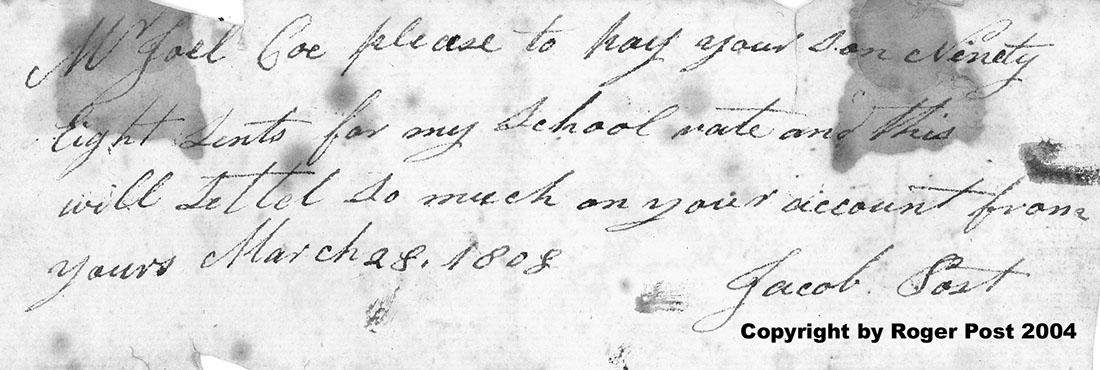
Jacob Post, Sr. Order to Joel Coe ca. 1808: A Document Relating to the Towns of Aurelius (later Fleming) and Scipio

An "Order" Issued by Jacob Post, Sr.

Jacob Post, Sr. operated a tannery and grain mill on what is now Stone School Road in the Town of Fleming, Cayuga Co., New York during the first several decades of the 19th Century. Note that Fleming was part of the Town of Aurelius before 28 March 1823. Among the loose papers found in the accounts ledger for the tannery was an "Order" for $0.98 issued by Jacob Post to Joel Coe. The Order directs Joel to pay $0.98 to his son - presumably Nathaniel Coe - in return for Jacob reducing Joel's debt on Jacob's account books by an equal amount. Jacob Post apparently owed $0.98 to Joel's son for the "school rate," essentially a school tax. Nathaniel Coe, Joel's younger son, was known to have been a School Teacher in later years and may have been working in a similar capacity at the time of Jacob's Order. The Order somewhat ambiguously references Joel's purchases of 28 March 1808, probably meaning Jacob's undated Order was issued at a later date but perhaps in the same year.

Images of the Order

Reverse side of an "Order" for $0.98 issued by Jacob Post, Sr. of Aurelius (later Fleming), Cayuga Co., New York to Joel Coe of Scipio, Cayuga Co., New York ca. 1808


Text of an "Order" for $0.98 issued by Jacob Post, Sr. of Aurelius (later Fleming), Cayuga Co., New York to Joel Coe of Scipio, Cayuga Co., New York ca. 1808

Transcription of the Order Text

"Mr. Joel Coe please to pay your son Ninety Eight Sents for my School rate and this will Settel so much on your account from yours March 28, 1808 - Jacob Post"


Bill of Exchange

Trading debt as a means of exchange is interesting in and of itself. The example of Joel Coe having debt held by Jacob Post and Jacob having a debt to Nathaniel Coe, and the respective debts being at least partially settled by Joel paying Nathaniel, appears to be efficient. Other examples can be found of such balancing of accounts during the early 19th Century. Jacob Post, Sr.'s Order to Joel Coe appears to be a financial instrument called a "Bill of Exchange," based on the following definition and explanation.

"The fore-runner to the modern cheque was the bill of exchange, originally a private transaction involving a money-lender. It was described by Robert Goodacre in A Treatise on Book-Keeping adapted to the use of Schools, published in 1818, as follows:   
'A bill of exchange[:]  written order drawn by one person A, on another person B, directing B to pay, on his account, a certain sum of money, therein specified, according to the direction of a third person, C.' 
The person ordering the exchange (A) was known as the 'drawer'. The person receiving the order (B) - the third party - was called the 'drawee'. The drawee would already have money on deposit from the drawer, or would be confident that the money would be repaid to him. Bills were usually endorsed (written on) by the drawee to indicate his acceptance of the bill. (C) was the 'payee', although this did not mean that he would always be paid the money in person. The payee 'directed' the payment of the money, meaning that it could either be paid to him, or he could order it to be paid to somebody else - for instance, in part-payment of one of his own debts. In such a case, the bill was endorsed by the payee with details of to whom the money should be paid, and transferred to that person." 
-- Manuscripts and Special Collections:  Cash Substitutes. University of Nottingham, UK - China - Malaysia.
https://www.nottingham.ac.uk/manuscriptsandspecialcollections/researchguidance/accounting/cashsubstitutes.aspx

Thus, Jacob would be the drawer of the Bill, Joel would be the drawee, and Nathaniel would be the payee. Jacob did not have money on deposit with Joel, but by canceling an equal amount of Joel's debt, Jacob effectively repaid Joel.

Joel Coe

Joel Coe and his family had come into Scipio, Cayuga Co., New York from Chester, Morris Co., New Jersey in 1795 and settled near Scipio Center. The account in Storke (1879) gives the location as about "three-fourths of a mile north of Scipio Center where Wm. Akin now [1879] lives." In fact, the location of William Akin's residence was slightly over 1 mile north of Scipio Center on Lot 16 as shown on an 1875 map of Scipio. Joel took up 640 acres at 1 shilling per acre, according to one account. Joel apparently sent some of his grain to market in the form of whiskey because Elisha Barnes, a somewhat later settler of Scipio who came in from Pharsalia, Chenango Co., New York in 1812, went to work for Joel in his distillery for a year before establishing his own operation in East Scipio in 1813. The account about Elisha Barnes places Joel Coe's distillery about 2 miles north of Scipio Center, but it seems more likely that it would have been on Joel's property and the distance not quite so far north.

We have to wonder why Joel Coe had to travel to Jacob Post's mill and tannery in an adjacent township, a distance of perhaps 6.5 miles. Joel could have been purchasing tanned leather. On the other hand, it is more amusing to speculate that Joel needed some malt ground for his whiskey-making operation. If we could only sample it now!