Showing posts with label Scipio. Show all posts

Sunday, August 25, 2019

Isaac Darrow, Jr.: Civil War Veteran and Mapleton Farmer

Isaac Darrow, Jr.'s Family Background

Isaac, Jr. was born in the Town of Owasco, Cayuga Co., New York on 29 July 1845, the son of Isaac Darrow, Sr. and Sarah Anne Sharpe. Sarah was the daughter of Jacob and Clarissa Sharp who lived in the towns of Venice and Scipio, Cayuga Co., New York in Sarah's youth. (Note:  Use of a terminal "e" on Sharpe is variable in this family.) The antecedents of Isaac Darrow, Sr. have not been identified.

The 1850 census does not reveal the whereabouts of the Darrow family, but in 1855 the family was censused in the adjacent Town of Niles, Cayuga Co., New York. They had moved to the Town of Sennett, Cayuga Co., New York by 1860 and returned to Owasco by 1863 as shown by Isaac Darrow, Sr.'s Civil War Draft Registration there during June of that year.

Isaac Darrow, Jr. in the Civil War

111th Infantry Regiment, New York Volunteers Formation and Early Battles

Isaac enlisted as a Private in the 111th Infantry Regiment, New York Volunteers at Owasco on 23 February 1864 at the age of 18. The 111th Regiment had been organized in Wayne and Cayuga counties during the summer of 1862 for service of three years after mustering into federal service at Auburn, Cayuga Co., New York on 20 August 1862 (1) (2). By the time of Isaac's enlistment, the 111th had experienced the humiliation of being surrendered at Harper's Ferry in September 1862, shortly after the regiment went into service, but had returned to participate in the momentous Battle of Gettysburg in July 1863. The 111th Regiment's subsequent engagements during 1863 and early 1864 occurred in Virginia and included Fall's Church, Lewinsville, Auburn, Bristoe Station, Blackburn's Ford, the Mine Run Campaign (Robertson's Tavern), and Morton's Ford (2) so Isaac was joining a battle-tested unit.

Battle of the Wilderness

Isaac joined Company A of the 111th Regiment following his enlistment (3). He would have traveled from Auburn to his unit's encampment, probably in Virginia. The 111th was not involved in any battles for several months following Isaac's enlistment. Isaac thus had time for training and gaining knowledge of combat from hardened veterans before being thrust into action. That action came with the Battle of the Wilderness, which began on 5 May 1864 (2). Isaac survived the first day of the battle but was seriously wounded in action on 6 May (3), presumably during the fighting on the Plank Road. Records show that Isaac was missing from the 30 June and 31 August 1864 muster rolls, apparently hospitalized from his injuries.

Capture and Prisoner of War

Military records show that Isaac had returned to duty with the 111th Regiment by late October 1864. During his absence, the 111th Regiment had participated in the battles of Spotsylvania Courthouse, North Anna, Totopotomoy, and Cold Harbor; the Assault of Petersburg; and the battles of Weldon Railroad, Deep Bottom, Strawberry Plains, and Ream's Station through 25 August 1864 (2). Isaac was transferred from Company A to Company G of the 111th Regiment as a Private on 29 October 1864 and had the great misfortune of being captured by Confederate forces the following day (3).

The details of Isaac's capture are not known. The 111th would not see significant action until the Battle of Hatcher's Run on 8-10 December 1864 (2). Thus, Isaac must have been captured while in a minor skirmish or perhaps while on picket duty or a detail away from other troops. Military records show that Isaac Darrow, Jr. was a prisoner of war until 10 April 1865, the day after Lee's surrender following the Battle of Appomattox Court House. Isaac was fortunate to survive the deprivation and disease prevalent in Confederate prison camps, but he may have been in poor health as a result. Isaac had not yet appeared on the muster roll of Company G, 111th Infantry Regiment by 30 April 1865. On 4 June 1865, Isaac was transferred to Company (Battery) G of the 4th Regiment, New York Heavy Artillery while noted as being absent sick from Company G, 111th Regiment since 27 May.

Isaac Darrow, Jr.'s Civil War Service came to an end on 30 June 1865 when he was mustered out of service at New York City.

Isaac Darrow, Jr.'s Life After the Civil War

Farm Work in the Town of Owasco and Town of Throop

The New York State census of 1865 shows Isaac's parents in Owasco and lists Isaac as a member of the household although at the time of the census (20 June 1865) Isaac had not yet been mustered out of the Army. As far as known, Isaac returned to his parent's household in early July 1865. The family had removed to the Town of Throop, Cayuga Co., New York by 1870. Isaac was in his father's household there, and both were listed as Laborers (probably doing farm work).

Marriage to Josephine Maine

Isaac Darrow, Jr. and Josephine Maine (Note:  Use of a terminal "e" is variable in this family) married on 23 September 1874. The location of the wedding  has not been found but may have been in the Town of Scipio, Cayuga Co., New York. Josephine was censused in Scipio in 1870 in the household of George G. Barnes, and her parents, Ephraim B. Main and Caroline L. Sharp, resided in the same town. Josephine was born in the Town of Aurelius, Cayuga Co., New York, most likely on 20 November 1853 (dates vary), making her 21 years old when she married. Caroline L. Sharp was a sister of  Isaac's mother, Sarah Anne Sharpe, which made Isaac and Josephine 1st cousins. Josephine was a great-granddaughter of Revolutionary War veteran, William M. Main.

Farm Work in the Town of Fleming and Town of Venice

Isaac and Josephine Maine were censused in the Town of Fleming, Cayuga Co., New York in 1875. Isaac was listed as a Farmer. He was not a landowner at this time but rather was a farm laborer or perhaps tenant farmer as evidenced by his later moves and identification as a laborer. Nearby landowners included Peter V. Wyckoff and Thomas Plunkett, which place Isaac and Josephine in the southeast corner of the town, probably on Lot 98 near Wyckoff Station on Owasco Lake.

By 1880, Isaac and Josephine are living in the Town of Venice, Cayuga Co., New York with three children:  Clarence (age 5), Martha (age 3), and Emma (age 1) - who later would appear both as Imogene and Jennie and went by the latter as an adult. Isaac is listed as a Laborer. His family appears in the census adjacent to that of Achsah Ulter whose residence can be found on the 1875 map of Venice in Lot 66 on present-day Lyons Road.

Scipio Landowner

The 1892 census places Isaac and his family in Scipio on the Fleming-Scipio Town Line Road at its intersection with present-day Cork Street, a short distance south of the hamlet of Mapleton in the Town of Fleming. This location can be found on the 1904 map of Scipio in Lot 2. Isaac was still listed as a Laborer in 1892 but presumably already owned the house shown on the 1904 map.

By 1900, the children had left home. Isaac and Josephine were homeowners at the location that they occupied in 1892, and Isaac was employed as a Farm Laborer. We know that Isaac was working for John H. Payne in 1904. The exact location of Payne's farm has not been found but seems to have been in the vicinity of present-day Walters Road in Scipio in the vicinity of Lot 13.
WAS BADLY BRUISED. Isaac Darrow, employed by John Paine [NOTE:  This name was given as John H. Payne in other sources - R. A. Post], of Scipio, met with a peculiar accident Wednesday. He was working on the load while hay was being unloaded by means of a horsefork. While a huge forkful was being drawn toward the roof of the barn the car broke and hay, tackle, fork and all came tumbling down on top of Darrow. He was badly bruised but no bones were broken. Dr. Frank C. Smith attended him. 
-- Thomas Tryniski (scan), Roger Post (transcriber), Was Badly Bruised (Auburn, Cayuga Co., NY, Auburn Weekly Bulletin, Friday, 29 July 1904), Old Fulton New York Post Cards http://www.fultonhistory.com
Isaac listed himself as a self-employed Farmer in 1910. He was then about 65 years old (listed as 67 in the census). One can only imagine Isaac's and Josephine's struggles and perseverance to achieve a modicum of independence over more than 30 years, which may have paled, however, when compared to Isaac's experiences as a prisoner of war in a Confederate prison. Isaac continued to farm through 1920, still living south of Mapleton, as shown by census data.

Reunions of the 111th Infantry Regiment, New York Volunteers

Veteran Isaac Darrow, Jr. of the 111th Infantry Regiment, New York Volunteers, seems to have regularly attended reunions of his regiment as the number of veterans dwindled with time. One memorable reunion occurred in 1910, hosted by General and Mrs. MacDougall on the grounds of their home on South Street in the City of Auburn, Cayuga Co., New York. Several hundred people attended this event. Isaac was listed among the veterans from Southern Cayuga County, along with Captain Marcus Wellington Murdock of Venice and Benjamin F. Gould and Morton M. Palmer of Scipio.

Possibly the most moving reunion of the 111th Regiment for Isaac was their trip to Gettysburg in 1913. Gettysburg was fought before Isaac joined the regiment, but he was surely schooled on the details of the battle by his fellow veterans.
"ON TO GETTYSBURG. . . . It was a jolly bunch of veterans of the Civil War who left  Auburn Saturday night for the battlefield of Gettysburg to enjoy a reunion of the Yanks and Johnny Rebs who participated in that bloody struggle which commenced just 50 years ago tomorrow and which was the deciding battle for the preservation of the Union in the great conflict of '61 to '65. . . . The following took the trip via the Lehigh Valley road from Auburn. . . . Isaac Darrow of Mapleton. . . ."
-- Thomas Tryniski (scan), Roger Post (transcriber), On To Gettysburg (Auburn, Cayuga Co., NY, The Auburn Citizen, Monday, 30 June 1913), Old Fulton New York Post Cards http://www.fultonhistory.com

Isaac is known to have attended a reunion of the 111th in 1916. He is not recorded as attending further reunions until 1923 although he likely did so. In 1918, Isaac was named as one of the surviving Civil War veterans in the local area. Veteran numbers had dwindled so much by that time that the veterans required assistance to carry out their traditional ceremonial duties on Memorial Day and at other times. Accordingly, the Sons of Veterans was formed in the local G.A.R. (Grand Army of the Republic) meeting rooms on Exchange Street in Auburn. By 1923 only 22 veterans of the 111th Regiment were able to attend their reunion at the G.A.R. rooms. Isaac Darrow was listed among them.

Retirement to New York State Woman's Relief Corps Home (aka Soldier's Home) at Oxford, Chenango Co., New York

Leaving Scipio

Isaac's health was failing in 1923, and he was nearly blind. He applied for admittance to the Woman's Relief Corps (W.R.C.) Home at Oxford, Chenango Co., New York for himself and his wife on 29 August 1923. Isaac listed among his assets a Civil War pension of $72/month, a small place with 3 acres of improved land worth $500, Josephine's small place where they lived worth $700, and a small bank deposit. Isaac and Josephine were approved for admittance to the W.R.C. Home.

Death of Josephine Maine Darrow

Josephine died at the W.R.C. Home on 29 July 1924, 11 months after she and Isaac had applied for admittance. Her funeral occurred at the Gross & Mosher Funeral Parlor on Lincoln Street in Auburn on 1 August 1924. Josephine is buried in the Fleming Rural Cemetery, not far from her former home in Scipio.

Remarriage of Isaac Darrow

On 23 March 1926, Isaac married Mary Zerua Burlison at Norwich, Chenango Co., New York. Mary had been twice married to Harvey Woods and Sherman L. Wade. Isaac and Mary determined to occupy their own home on Green Street in Oxford; therefore, Isaac left the W.R.C. Home.

Death of Isaac Darrow, Jr.

Isaac died on 29 January 1927, less than a year after he married Mary Z. Burlison. He must have returned to the W.R.C. Home in his final days because the Home is listed in his obituary as his place of death. No record has been found of Isaac's funeral. It may well have occurred at Norwich or Oxford before his remains were brought to Fleming Rural Cemetery for burial on 2 February 1927. Isaac was survived by his second wife and her children, his daughter Martha Ann Darrow Strang, and his son Clarence Darrow. His daughter, Imogene (aka Jennie) Darrow Baker, predeceased him in 1911.

Selected References

(1) Hall, Henry. The History of Auburn. Auburn, New York: Dennis Bro's & Co., 1869. (see pp. 429-435)
https://archive.org/details/historyofauburn01hall/page/428

(2) Phisterer, Frederick. New York in the War of the Rebellion. Volume 4. Third Edition. Albany, New York: J. B. Lyon Company, State Printers, 1912.  (see pp. 3305-3306)
https://archive.org/details/phisterernewyork04fredrich/page/3304

(3) New York State Adjutant General Office. Rosters of the New York Infantry Regiments during the Civil War. Albany, New York: New York State Division of Military and Naval Affairs, New York State Military Museum and Veterans Research Center, 2010. 
http://dmna.ny.gov/historic/reghist/civil/rosters/Infantry/111th_Infantry_CW_Roster.pdf

NOTE:  Additional uncited information was obtained from a commercial genealogy website and newspaper items.

Tuesday, December 4, 2018

Account of Peter Herring (aka Peter Reed Harring) in the Tannery Ledger of Jacob Post, Sr.

Peter Reed Harring (aka Herring)

An account bearing the name "Peter Herring" appears in the Tannery Ledger of Jacob Post, Sr. Investigation reveals that this man most probably was Peter Reed Harring, son of Daniel D. Harring and Mary D. Reed who are buried in Fleming Hill (Rural) Cemetery. Daniel Harring (spelled Herring in this record) appears in the 1800 federal census for the Town of Aurelius, Cayuga Co., New York with his wife, three young males, and five young females in his household. The family appears again in 1810 (under Daniel D. Haring) with the same number of children in the household. Daniel D. Harring died in 1813. Before his death, he was among a group who withdrew from what would become the First Presbyterian Church of Springport to found the First Presbyterian Church of Auburn (Storke, 1879: p. 370).

Peter Reed Harring was born 6 June 1801 in Aurelius. His was baptized on 2 August 1801 at the Reformed Dutch Church of Owasco (as Peter Reed Herring).
Name: Peter Reed Herring; Gender: Male; Christening Date: 02 Aug 1801; Christening Place: DUTCH REFORMED CHURCH, OWASCO, CAYUGA, NEW YORK; Birth Date: 06 Jun 1801; Father's Name: Daniel Herring; Mother's Name: Mary Reed; Indexing Project (Batch) Number: C50632-1; System Origin: New_York-ODM; GS Film number: 17834
-- "New York Births and Christenings, 1640-1962," database, FamilySearch (https://familysearch.org/ark:/61903/1:1:FDP6-Q56 : 11 February 2018), Peter Reed Herring, 06 Jun 1801; citing , reference ; FHL microfilm 17,834.
 Mary Harring (as Herring) was censused as head of household at Aurelius in 1820. Peter presumably was part of his mother's household, which included a male between 16 and 25 years of age. The Town of Fleming, Cayuga Co., New York was taken off Aurelius in 1823, and Peter (as Herring) appears there as a head of household in the 1830 federal census. His household included a female of 60-69 years of age, probably his mother, Mary, who lived until 1854.

A Peter R. Harring of the correct age, with wife Permelia Squires, is found in census data for Dover, Lenawee Co., Michigan beginning in 1845 and continuing through 1860. Peter was listed as a Carpenter in 1850. He died in 1862 and is buried at Osseo, Hillsdale Co., Michigan in East Hill Cemetery.

Images of Peter Reed Harring's (aka Herring) Account in Jacob Post, Sr.'s Tannery Ledger


Debit Page (2A Bottom) for Peter Herring's (aka Harring) Account at the Tannery of Jacob Post, Sr. - Fleming, Cayuga Co., New York

Credit Page (2B Bottom) for Peter Herring's (aka Harring) Account at the Tannery of Jacob Post, Sr. - Fleming, Cayuga Co., New York

Note that Peter's debits appear in two different places on the debit page image, separated by two other brief accounts. Jacob Post, Sr. probably was returning to the front part of his ledger to find unused space after filling the rest of the tannery ledger over the years since he began it in 1811.

Transcription of Peter Reed Harring's (aka Herring) Account


Peter Herring [Harring] Debit Peter Herring [Harring] Credit
Date
Description
S
d
Date
Description
S
d
May 5, 1827 To two Skins
0
16
0
No Date Credit By one hide wt 40 lb
0
16
0
December 6, 1827 To Leather
1
9
6


January 4, 1828
To ½ Side of uper [upper] got Peter Read
0
13
0


To one Saf [calf?] skin got by Peter Read
0
14
0


April 20, 1828
To 6 bushels of weet [wheat]
To one Sheap [sheep] Skin
0
4
0


To one Side of Soalleather [sole leather] wt 11¼ lb
1
2
6


Subtotal [not shown] =
4
19
0


Subtotal [not shown] =
0
16
0
December 1, 1828
To one Skin
1
0
0


To 2/1 [½] Side of Soleather [sole leather] wt 6½ lb
0
13
0


And ½ Side of uper [upper] got by Lukes [Lukas]
0
13
0


Total [not shown] =
7
5
0


Total [not shown] =
0
16
0


Peter Reed Harring's (aka Herring) Purchases and Credits

Peter bought leather over a period of less than 2 years in 1827-1828. He would have been in his late 20s and living in Fleming, probably on his mother's property. Where Peter lived in the Town of Fleming is not clear but may have been in the vicinity of Fleming village given his father's burial at Fleming Hill (Rural) Cemetery. He did not live in the immediate vicinity of Jacob Post, Sr.'s tannery near Owasco Lake but appeared in the 1830 census several pages away from the Posts and Petersons  who lived along the western shore.

Peter's purchases were mainly of various types of leather, both sole leather and upper leather. In addition, he bought two unspecified skins, a sheepskin, and 6 bushels of wheat. The value of the wheat is somewhat unclear. Jacob made an entry of 4 shillings after the the sheepskin and entered nothing after the wheat. One or the other or both may have cost 4 shillings. Another entry concerns an item that appears as "Saf skin," as near as can be made out. Possibly it was for calfskin.

A "Peter Read" picked up several of the items for Peter Harring. This surname likely should have been spelled Reed, the maiden name of Peter Reed Harring's mother, given that "Peter Read" appears to have been a relative living in his household. Another leather purchase was picked up by "Lukes," probably Lucas, surname unknown but presumably a member of Peter Harring's household.

Peter Harring had only one undated credit entry shown, a hide weighing 40 pounds and valued at 16 shillings. This credit was against debits summing to 7 pounds 5 shillings. Peter appears to have owed Jacob a net of 6 pounds 9 shillings. There is no record of how, or if, Peter paid the balance of his account. Nevertheless, Jacob X'd out the account, indicative of payment in some fashion.


Sunday, December 2, 2018

Account of John Roraboc (aka John Roraback) in the Tannery Ledger of Jacob Post, Sr.

John Roraback

Storke (1879: p. 422) identifies John Roraback as of German origin and an early settler of the Town of Scipio, Cayuga Co., New York. Roraback later removed to "Crooked Lake," an historical name for Keuka Lake based on its forked shape. The family surname suffered from a variety of phonetic spellings. The Tannery Ledger of Jacob Post, Sr. shows the name as John Roraboc. Other variants were "Roorbach," "Rorabaugh," "Roerbach," and "Roreback."

Census and Tax Data

John Roraback may have settled briefly in the Town of Aurelius, Cayuga Co., New York before 1800 because he appears there in the Tax Assessment Rolls of 1800.
Jno Roreback; Assessment Year: 1800; Assessment Place: Aurelius, Cayuga, New York, USA; Residence Year: 1800; Residence Place: New York, USA; Transcription:  'Roreback, Jno.  [Description] Barn and Farm  [Real Estate] $100  [Personal Estate] $46  [Total Amount] $146  [State Tax] $0.15  [County Tax] $0.10'
-- New York (State), Comptroller's Office. Tax Assessment Rolls of Real and Personal Estates, 1799–1804. Series B0950 (26 reels). Microfilm. New York State Archives, Albany, New York. [From Ancestry.com]
John's real estate, valued at $100, probably represented a fairly small property because other farms in the town had values two to five times (or more) higher.  The quoted tax record does not identify where in the Town of Aurelius John was located, the entries being in alphabetical order. Part of Aurelius was taken off as the Town of Fleming (Cayuga County) in 1823 so John may have been located in either of today's towns.

The 1800 federal census for the Town of Scipio shows the family of a "John Roorbach," believed to be the same person as the man who paid taxes that year in Aurelius. This must be the year that John settled in Scipio, as referenced by Storke. The census data reveal that John and his wife had three additional young males and four additional young females in their household. Both John and his wife are listed as between 26 and 44 years old.

A "John Rorabaugh" appears in the 1810 federal census for Scipio. He and his wife were listed as 45 or more years old. Their births thus would have occurred no later than 1765. Two boys and two girls appear in John's household in this census. It may be that three of the four children appearing in the previous census as age 10 or older had, if living, established their own households by 1810.

Consistent with Storke's reference to John Roraback removing from Scipio to "Crooked Lake," a "John Roerbach" appears in the 1820 federal census for the Town of Milo (later incorporated in Yates County), Ontario Co., New York. Milo abuts the eastern shore of Keuka Lake. John's household in 1820 included four males and three females in addition to John and his wife. Some of these household members may have included one or more of John's married children with spouses.

John Roraback's Death

John died on 19 January 1829 in Yates Co., New York. At the time of his death, his wife was listed as Ann Margaret Roraback with the implication that he had been married more than once. Names of heirs in the written record are somewhat confusing. Children John, Adam, and Nancy are listed as heirs at law. Betsey and Peggy appear to be children of a first marriage and their respective spouses were Alexander McConnell and James McConnell. Two other children, Jacob and Polly, are listed as children of Ann Margaret Roraback, but not as heirs, so may have been deceased or stepchildren of John Roraback.
Name: John Roraback; Event Type: Death; Event Date: 19 Jan 1829; Spouse's Name: Ann Margaret Roraback; Digital Folder Number: 004696957; Image Number: 00805
-- New York, Yates County, Swann Vital Records Collection, 1723-2009," database with images, FamilySearch (https://familysearch.org/ark:/61903/1:1:QJ8B-XSTR : 12 March 2018), John Roraback, 19 Jan 1829; citing Death, , Yates County Genealogical and Historical Society and Oliver Museum and Underwood Museum, Yates.


Images of John Roraback's (aka Roraboc) Account in Jacob Post, Sr.'s Tannery Ledger


Debit Page (2A Top) for John Roraboc's (aka Roraback) Account at the Tannery of Jacob Post, Sr. - Fleming, Cayuga Co., New York

Credit Page (2B Top) for John Roraboc's (aka Roraback) Account at the Tannery of Jacob Post, Sr. - Fleming, Cayuga Co., New York


Transcription of John Roraback's (aka Roraboc) Account


John Roraboc [Roraback] Debit John Roraboc [Roraback] Credit
Date
Description
S
d
Date
Description
S
d
October 8, 1810 To Sundries
8
2
4
January 4, 1811 By Sundries
5
14
2
November 21, 1811 To Leather
2
14
0
November 21, 1811 By Sundries
1
9
2
October 6, 1812
To ½ Side of uperleather [upper leather] And
0
14
0
November 21, 1811
By Sundries
1
4
0
½ Side of Soalleather [sole leather]
1
0
6
December 16, 1812
By two hids [hides] wt 161 lb
3
4
5
December 16, 1812
To ½ Side of uperleather [upper leather] And ½ Side of Soalleather [sole leather]
1
9
6
November 4, 1813
By Cash
4
12
7
September 17, 1813
To one Side of Soalleather [sole leather] – wt 22 lb
2
4
0


Total =
16
4
4


Total =
16
4
4
November 4, 1813
To ½ Side of Soalleather [sole leather] wt 5¾ lb
0
11
6


November 10, 1813
To one Side of uperleather [upper leather]
1
12
0
February 14, 1814
By Cash
2
3
6


Total =
2
3
6


Total =
2
3
6


John Roraback's (aka Roraboc) Purchases and Credits

Jacob Post, Sr.'s Tannery Ledger was put into use in November 1811 after being drafted by Dr. Jacob Bogart. John Roraback's account must have existed in earlier account books of Jacob Post, Sr. because a balance of 8 pounds 2 shillings and 4 pence dating from October 1810 was brought forward to the new ledger. A credit of 5 pounds 14 shillings and 2 pence in John's favor dating from January 1811 was brought forward as well.

John Roraback purchased leather from Jacob Post, Sr. during the fall of the year in each of 1811, 1812, and 1813. This would indicate that John worked with leather during the winter season when field work was done until the subsequent spring. Most of the leather purchased was of the classes called "upper leather" and "sole leather," presumably based on their respective suitable characteristics (thickness and stiffness) for making the upper parts and soles of boots and shoes. John spent roughly 2 each year for leather.

John offset his purchases in November 1811 by providing Jacob Post, Sr. with "sundries." We can't know what the sundries were, but they may well have consisted of green hides or farm products such as grain, fruits, or vegetables. The following year, it was in fact two hides that John applied to his credit account with Jacob. John paid cash in November 1813 to settle his account in full before proceeding on the same day to get another winter's worth of leather. These debits were settled by cash in February 1814.

We can see that John Roraback was an honorable man who settled his accounts. The fact that John bought no more leather after late winter 1814 may indicate that 1814 was the year in which he removed to Milo, Ontario Co. (later Yates Co.), New York near Keuka Lake where he was censused in 1820.

Wednesday, October 17, 2018

Account of Caleb Wadams, Sr. in the Tannery Ledger of Jacob Post, Sr.

Who Was Caleb Wadams, Sr.?

Caleb Wadams, Sr. was an early settler of the Town of Scipio, Cayuga Co., New York. His parentage is uncertain. He seems to have been born in Connecticut. A number of persons surnamed "Wadhams" were found at Goshen, Litchfield Co., Connecticut, and Caleb was recorded on at least one occasion under this spelling of his surname. A complete discussion of Caleb can be found on pages 537-539 of Wadhams Genealogy:  Preceded by a Sketch of the Wadham Family in England. This account includes Caleb's Revolutionary War service as an Artificer, in his case Carpenter, with an artillery regiment for 4 years. After his discharge, he married Eunice Farr in Dutchess Co., New York, the same county from which he enlisted in 1777.

Caleb and Eunice were censused at Freehold (then part of Albany Co.), Greene Co., New York in 1790. The Wadhams Genealogy states that Caleb purchased 200 acres of land in Scipio from Jonathan Fitch in 1795, at which time Caleb was living in Unadilla, Otsego Co., New York. Caleb and Eunice must have made their way to Scipio with their family sometime between 1795 and 1800. The 1800 federal census for Scipio lists a Caleb "Watham" as Head of Household, but no entry appears for his age. It is possible that the absence of his age entry is due to a hole or tear in the original records for Cayuga County, which are rife with such defects.

The location of Caleb's property appears to have been in the general vicinity of the present-day Scipio Town Offices north of Scipio Center. Caleb's close neighbors included Peter and Frederick Van Liew and Joel Coe who are known to have settled in that area. Caleb was censused at Scipio through 1830. Caleb's 1st wife, Eunice (aka Ruth), died in 1813. He married 2nd Mary Rude (aka Rood) Hammond, widow of Luthan Hammond. Mary died in 1832. Caleb died on 18 May 1835 and was buried in Cornwell Cemetery. One possible error in the Wadhams Genealogy may concern Caleb's date of birth. Given his known date of death and age at death, his calculated birth date would have been 14 January 1752, rather than 14 January 1754 as listed in the genealogy.

Caleb Wadams' Tannery Account

Ledgers in Early 19th-Century Accounting

Individual accounts for persons dealing with the tannery of Jacob Post, Sr. occupy facing pages, with the debits appearing on the left page and the credits on the right page. When a customer required leather or other goods of Jacob, the transaction was called a debit to the customer's account and entered on the left page. Conversely, when a customer reimbursed Jacob for all or part of their past purchases the amount was entered as a credit to the customer's account on the right page. Debits and credits ideally balanced out at some point, in which case the totals might be struck through to indicate cancellation.

Images of Caleb Wadams, Sr.'s Account in Jacob Post, Sr.'s Tannery Ledger


Debit Page for Caleb Wadams, Sr.'s Account at the Tannery of Jacob Post, Sr. - Fleming, Cayuga Co., New York

Credit Page for Caleb Wadams, Sr.'s Account at the Tannery of Jacob Post, Sr. - Fleming, Cayuga Co., New York

Note that Jacob Post, Sr. kept his accounts in pounds, shillings, and pence. This system was used in private trade into the 1840s, long after the adoption of the dollar. In brief, 12 pence (d) equalled a shilling (S) and 20 shillings equalled a pound (₤).

Transcription of Caleb Wadams, Sr.'s Account


Caleb Wadams
Debit
Caleb Wadams
Credit
Date
Description
S
d
Date
Description
S
d
March 21, 1811 To sundries from Day Book
13
5
0
May 11, 1810 By sundries
4
17
0
November 19, 1811 To one side of up[p]er
1
10
0
June 4, 1813 By one hide wt 58 lb
1
3
3
April 15, 1812 To ½ side of up[p]er leather And ½ sid[e] of soal [sole] leather
1
10
6
By one skin
0
10
0
September 21, 1812 To one side of up[p]er leather
1
8
0
By one skin
0
8
0
And ½ side of soal [sole] leather 6¼ lb
0
12
6
By one skin ½
0
8
0
November 20, 1812 To ½ side of soal [sole] leather And one pair of boot legs
1
10
0


Subtotal=
7
6
3
December 10, 1812 To one horse hide
0
14
0
February 16, 1814 By Cash
3
12
0
October 13, 1813 To one side of soal [sole] leather
1
6
0
27 September, 1814 By Cash
4
0
0
November 9, 1813 To one side of up[p]er leather
1
6
0
January 16, 1815 By Cash
8
0
0


Subtotal=
23
2
0


Subtotal=
22
18
3
May 12, 1814 To tanning one skin
0
10
0
December 11, 1816 By one hide wt 68 lb
1
12
8
June 1, 1814 To one skin tan[ne]d
0
9
0
By Cash
6
1
10
July 5, [1814] To ½ side of soal [sole] leather
0
11
6


Total=
30
12
9
September 24, 1814 To one side of soal [sole] leather And one kipskin [kipskin is leather between cowhide and calfskin in grade]
1
5
0
February 24, 1819 By Cash [underscored amount struck through]
0
8
0
0
15
0
February 9, 1820 By one [hide] wt 75 lb [underscored amount struck through]
1
16
0
December 26, 1814 To tan and cur[e] 1 kipskin
0
7
0


To 1 kipskin by John
1
4
0


Subtotal=
28
3
6


May 15, 1815 To one side of soal [sole] leather wt 10¾ And ½ side of up[p]er
1
4
3


0
13
0


June 1, 1816 To tanning one skin
0
12
0


Total=
30
12
9


February 24, 1819
To ½ side of soal [sole] leather wt 9¾ lb [underscored amount struck through]
1
4
3


Caleb Wadams, Sr.'s Purchases and Credits

Caleb Wadams, Sr. purchased leather from Jacob Post, Sr. one or more times per year from before 1811, as indicated by a substantial debit amount brought forward to 21 March 1811, presumably from an older ledger, and continued on a regular basis until 1816. Then a gap occurs until a final purchase in 1819. Caleb frequently purchased sole leather and upper leather. He was known as a carpenter, not a shoemaker, but as a craftsman, Caleb may have made the occasional boot. Alternatively, the leather might have gone to items required for farming, such as harnesses, bellows for forging, or leatherwork for carts or wagons.

Caleb used both cash and green hides on the credit side of his account. Reference to "sundries" in both the debit and credit columns was simply a way to group items that would have been chronologically detailed elsewhere in a "day book" before being entered in the ledger. It appears that green hides were valued by the pound, all else being equal. Presumably these hides came from butchered cattle and seem to have been fairly valuable.

The final debit and credit entries of 24 February 1819 and credit entry of  9 February 1820 do not balance. Nevertheless, the original image shows that they were struck through and thus cancelled. An unrecorded transaction or payment might explain this discrepancy.


Tuesday, September 25, 2018

Jacob Post, Sr. Order to Joel Coe ca. 1808: A Document Relating to the Towns of Aurelius (later Fleming) and Scipio

An "Order" Issued by Jacob Post, Sr.

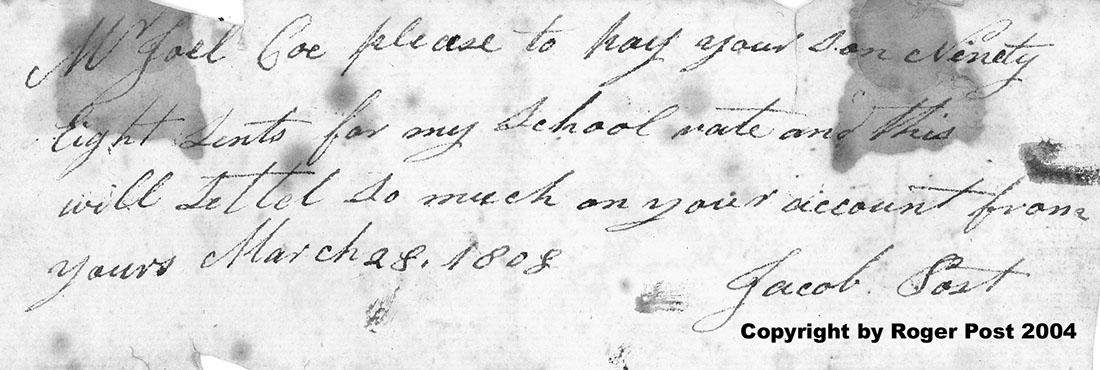
Jacob Post, Sr. operated a tannery and grain mill on what is now Stone School Road in the Town of Fleming, Cayuga Co., New York during the first several decades of the 19th Century. Note that Fleming was part of the Town of Aurelius before 28 March 1823. Among the loose papers found in the accounts ledger for the tannery was an "Order" for $0.98 issued by Jacob Post to Joel Coe. The Order directs Joel to pay $0.98 to his son - presumably Nathaniel Coe - in return for Jacob reducing Joel's debt on Jacob's account books by an equal amount. Jacob Post apparently owed $0.98 to Joel's son for the "school rate," essentially a school tax. Nathaniel Coe, Joel's younger son, was known to have been a School Teacher in later years and may have been working in a similar capacity at the time of Jacob's Order. The Order somewhat ambiguously references Joel's purchases of 28 March 1808, probably meaning Jacob's undated Order was issued at a later date but perhaps in the same year.

Images of the Order

Reverse side of an "Order" for $0.98 issued by Jacob Post, Sr. of Aurelius (later Fleming), Cayuga Co., New York to Joel Coe of Scipio, Cayuga Co., New York ca. 1808


Text of an "Order" for $0.98 issued by Jacob Post, Sr. of Aurelius (later Fleming), Cayuga Co., New York to Joel Coe of Scipio, Cayuga Co., New York ca. 1808

Transcription of the Order Text

"Mr. Joel Coe please to pay your son Ninety Eight Sents for my School rate and this will Settel so much on your account from yours March 28, 1808 - Jacob Post"


Bill of Exchange

Trading debt as a means of exchange is interesting in and of itself. The example of Joel Coe having debt held by Jacob Post and Jacob having a debt to Nathaniel Coe, and the respective debts being at least partially settled by Joel paying Nathaniel, appears to be efficient. Other examples can be found of such balancing of accounts during the early 19th Century. Jacob Post, Sr.'s Order to Joel Coe appears to be a financial instrument called a "Bill of Exchange," based on the following definition and explanation.

"The fore-runner to the modern cheque was the bill of exchange, originally a private transaction involving a money-lender. It was described by Robert Goodacre in A Treatise on Book-Keeping adapted to the use of Schools, published in 1818, as follows:   
'A bill of exchange[:]  written order drawn by one person A, on another person B, directing B to pay, on his account, a certain sum of money, therein specified, according to the direction of a third person, C.' 
The person ordering the exchange (A) was known as the 'drawer'. The person receiving the order (B) - the third party - was called the 'drawee'. The drawee would already have money on deposit from the drawer, or would be confident that the money would be repaid to him. Bills were usually endorsed (written on) by the drawee to indicate his acceptance of the bill. (C) was the 'payee', although this did not mean that he would always be paid the money in person. The payee 'directed' the payment of the money, meaning that it could either be paid to him, or he could order it to be paid to somebody else - for instance, in part-payment of one of his own debts. In such a case, the bill was endorsed by the payee with details of to whom the money should be paid, and transferred to that person." 
-- Manuscripts and Special Collections:  Cash Substitutes. University of Nottingham, UK - China - Malaysia.
https://www.nottingham.ac.uk/manuscriptsandspecialcollections/researchguidance/accounting/cashsubstitutes.aspx

Thus, Jacob would be the drawer of the Bill, Joel would be the drawee, and Nathaniel would be the payee. Jacob did not have money on deposit with Joel, but by canceling an equal amount of Joel's debt, Jacob effectively repaid Joel.

Joel Coe

Joel Coe and his family had come into Scipio, Cayuga Co., New York from Chester, Morris Co., New Jersey in 1795 and settled near Scipio Center. The account in Storke (1879) gives the location as about "three-fourths of a mile north of Scipio Center where Wm. Akin now [1879] lives." In fact, the location of William Akin's residence was slightly over 1 mile north of Scipio Center on Lot 16 as shown on an 1875 map of Scipio. Joel took up 640 acres at 1 shilling per acre, according to one account. Joel apparently sent some of his grain to market in the form of whiskey because Elisha Barnes, a somewhat later settler of Scipio who came in from Pharsalia, Chenango Co., New York in 1812, went to work for Joel in his distillery for a year before establishing his own operation in East Scipio in 1813. The account about Elisha Barnes places Joel Coe's distillery about 2 miles north of Scipio Center, but it seems more likely that it would have been on Joel's property and the distance not quite so far north.

We have to wonder why Joel Coe had to travel to Jacob Post's mill and tannery in an adjacent township, a distance of perhaps 6.5 miles. Joel could have been purchasing tanned leather. On the other hand, it is more amusing to speculate that Joel needed some malt ground for his whiskey-making operation. If we could only sample it now!

Saturday, September 22, 2018

William Smead, Jr.: Revolutionary War Veteran and Early Settler of Scipio

Family History of William Smead, Jr. (1742-1815)

William Smead II (ca. 1626-ca. 1703)

The Smead Family has a long history in the New World, beginning with a William Smead II, son of William Smead I (ca. 1595-ca. 1628), who was first brought from Gravesend, Kent, England in the fall of 1635 to the island of Barbados in the eastern Caribbean by his twice-widowed mother, Judith Stoughton Denman Smead. The family subsequently arrived at Dorchester in the Massachusetts Bay Colony in 1636. Judith died there about 3 years later. William Smead II lived at Dorchester over the next two decades, removing to Northampton, Hampshire Co., Massachusetts in 1660, not long after marrying Elizabeth Lawrence. In 1684, William and Elizabeth removed to Deerfield, Franklin Co., Massachusetts where William died ca. 1703.

John Smead I (1673-1720)

Among the children of William Smead II and Elizabeth Lawrence was a son, John Smead I (an earlier son of the same name died young) born 27 August 1673 at Northampton, Hampshire Co., Massachusetts. John married Anna Weld at Deerfield on 22 November 1699. They resided at nearby Wapping. John was wounded by Indians during the "Deerfield Massacre" of 1704 and carried a musket ball in his thigh for the rest of his life. Thus began what seemed to be a propensity of Smeads to suffer Indian attacks, perhaps because they repeatedly settled on the frontiers of the day. John served as a Selectman and Assessor before his death at Wapping on 30 April 1720.

Ensign William Smead, Sr. (1706-1797)

[NOTE:  William Smead, Sr. appears with the surname spelling "Smeed" on his tombstone and in most contemporary records. Earlier and later generations generally used "Smead."]

This William Smead -- who might also be considered another William Smead I given his son and grandson named William -- was born to John and Anna Weld Smead at Deerfield on 22 October 1706. At the age of 27, William became a Proprietor of the Upper Township on Ashuelot River in 1734 with the payment of 5 pounds for an 8-acre house lot in the wilderness up the Connecticut River. The initial lots would accommodate about 60 families under a land grant from the Massachusetts Bay Colony. This area would later become Keene, Cheshire Co., New Hampshire. Year-round occupancy of the new settlement began in the spring of 1737 after several years of summer work laying out the house lots and surveying additional lots to support agricultural activity.

William married Phebe Partridge on 9 November 1738 at Medway, Norfolk Co., Massachusetts. As far as known, Phebe accompanied her husband back to the Upper Township on Ashuelot River following their marriage. William was by this time a Sergeant in the local militia, and events on the frontier would require his service within the following decade. King George's War, later locally known as the Old French and Indian War, caused removal of all the settlers from the Upper Township in March 1747. Where William moved his family is not evident but may have been to Deerfield or to Medway where Phebe's mother yet lived. William, however, returned to the frontier to serve as Sergeant in Captain Josiah Willard, Jr.'s Company at Fort Dummer (near present-day Brattleboro, Windham Co., Vermont) and at Ashuelot for the duration of the War, mustering out on 26 October 1748.

William and Phebe probably returned to the Upper Township on Ashuelot River in the spring of 1749. The settlement largely had been destroyed by the French and Indians, necessitating reconstruction of houses and outbuildings. In 1753, the Proprietors after many petitions to the government of New Hampshire finally succeeded in getting their land grant from Massachusetts rechartered as Keene by New Hampshire to reflect the contemporary colonial borders. The Smeads again seemed to attract French and Indian attacks with the outbreak of the Seven Years' War, locally called the New French and Indian War. William's military rank was specifically noted as Ensign between 1755 and 1760, indicating continuing militia service while he also served 4 years as Selectman.

The family remained in Keene until about 1761 when William sold extensive tracts of land after they had already removed to nearby Walpole, Cheshire Co., New Hampshire. William and Phebe resided at Walpole through 1767. By 1771, the family was in Windsor, Windsor Co., Vermont where they remained. Ensign William Smead, Sr. died 26 October 1797 at Windsor.

William Smead, Jr. (ca. 1742-1815)

The first two sons of William Smead, Sr. and Phebe Partridge, Asa and Joel, died in 1744. William and Phebe later would have two more sons bearing those names. William Smead, Jr. -- who might also be called William Smead II given his father and son named William -- was the third son of William and Phebe, probably born in 1742 at the Upper Township on Ashuelot River. William, Jr., as far as known, grew up on the family lands there and presumably removed with his parents to Walpole ca. 1761. He married Mehetebell Brown at Walpole on 20 August 1767, the ceremony being performed by Rev. Thomas Fessenden of the newly formed Walpole Church of which William's father, and probably mother, were founding members earlier that year.

William Smead, Jr. appears as a Head of Household in a census taken at Windsor in 1771, indicating that he and Mehetebell had removed there from Walpole at about the same time as his parents. William's deed at Windsor was reconveyed in 1772 following a change in jurisdiction of the area from New Hampshire to New York. By 1777, William, Jr. is censused at Cornish Township, Sullivan Co., New Hampshire. This area is directly across the Connecticut River from Windsor.

William Smead, Jr. in the Revolutionary War

The Revolutionary War did not seem to affect William in 1777, despite the Battles of Saratoga being fought in September and October, not far from Vermont. However, Major Ebenezer Woods directed that men from Windsor conduct scouting activities between June and September 1778. A William Smead served as a Scout for 3 days during this time. It is likely that the "Wm. Smead" shown on the rolls of Vermont was William Smead, Jr. because his father was then 71 years old.

William was not called to serve again until 1780. Between 2 August and 8 August of that year, William was a member of Captain John Mercy's Company (also seen as Captain John Marcy's Company) for 6 days when they marched 20 miles in pursuit of Tories on the order of Colonel Ebenezer Woods of Windsor. William's pay rate was 1 shilling 4 pence per day. He received a mileage rate of 4 pence per mile. His total pay for this period was 14 shillings 8 pence.

William again served from 20 October to 31 October 1780 in Lieutenant Asahel Smith's Company, Vermont Militia, marching to Fort Fortitude by order of Lieutenant Colonel Safford. The Fort was located at Bethel, Windsor Co., Vermont near the White River, but the exact location has been lost. Captain Smith's Company marched 40 miles during this time, for which William's total pay was 1 pound 8 shillings.

No further reference to William Smead, Jr. appears in the Vermont records of Revolutionary War soldiers. We can presume that William returned to his land in or near Windsor after each of his brief forays scouting or with the militia. In terms of Revolutionary War service, William's total time of 20 days was minimal and may not have included any actual combat. Nevertheless, we honor the fact that William was a patriot who contributed to securing independence for the Colonies.

William Smead, Jr. and Settlement of Scipio

No records of William and Mehetebell Brown Smead in the decade between the William's last Revolutionary War service and the first federal census in 1790 are readily accessible. At some point, the family must have removed from the area of Windsor because William appears at Queensbury, Washington Co., New York (now Queensbury, Warren Co., New York) in the referenced census, adjacent to David Eddy. The Smead and Eddy families must have moved westward together to settle in the Town of Scipio, Cayuga Co., New York before 1800 because they are again adjacent in the 1800 federal census of Scipio, thus beginning what would be a long association between the families. No mention of William Smead, Jr.'s settlement in Scipio appears in Storke's (1879) account of this period. One bit of evidence may be gleaned from the date of David Eddy's settlement, as known from an account by his son, Owen, who stated that David moved to Scipio when Owen was 8 years old. That would make the year ca. 1795. We can speculate that William Smead, Jr.'s family came in at the same time, given their adjacent locations in 1800.

William Smead, Jr. probably resided on present-day Bergerstock Road in the Town of Scipio. His oldest living son (as of 1800), William Smead III , appears there (with surname spelled "Smeed") on an 1853 map of Scipio, presumably having inherited his father's land. The Smead farm was on the north side of the block where David Eddy, whose farms were on present-day Manchester and Black Street roads, settled. William Smead, Jr. died on 17 February 1815. His wife, Mehetebell, died on 6 January 1823. Both are buried in the Eddy Cemetery on Manchester Road.

Monument for Revolutionary War veteran William Smead, Jr. and his wife, Mehetebell Brown Smead in Eddy Cemetery, Manchester Road, Scipio, Cayuga Co., New York

Children of William Smead, Jr. and Mehetebell Brown Smead

William and Mehetebell had four living sons when the family settled Scipio:  William Smead III (aka William Smead, Jr.) (1779-1860), Jedediah Levens Smead (1781-1865), Marshall Smead (1784-1853), and Allen Smead (1788-1858). Their first son, David Smead, died at Walpole in 1768, probably at or near birth. One source references a William Smead baptized on 17 May 1772 at Windsor. This William may have died young because William Smead III appears to have been born in 1779. Other, unrecorded, children also may have been born and died young during the 11-year gap between David and William Smead III.

With the exception of William Smead III of  Bergerstock Road, the sons of William and Mehetebell eventually removed to the western portion of New York State settling in Livingston and Genesee counties, where they left many descendants, including some who later returned to Scipio.