Friday, October 5, 2018

List of Accounts in the Tannery Ledger of Jacob Post, Sr. of Fleming, Cayuga Co., New York

The Tannery Ledger

Jacob Post, Sr. settled with his father, Christopher Willemsz. Post, on the western shore of Owasco Lake in 1796 on Lot 91. The area was part of the Town of Aurelius until 1823 when it was taken off as the Town of Fleming. Jacob is known to have operated a tannery, and by some accounts a grain mill, on present-day Stone School Road. When the tannery began operation is not known; however, tannery accounts between 1811 and about 1820 are documented in a ledger book. The book continued in use beyond 1820 on a less regular basis, perhaps because of declining tannery business.

The Ledger and Dr. Jacob Bogart

Jacob Post, Sr. had a ledger book prepared for his tannery on 7 November 1811 by Jacob Bogart. It is worth noting that Jacob Bogart, the scribe whose fine hand who prepared the tannery ledger book, was actually a Physician who had settled near the foot of Owasco Lake by 1800, as shown by the Aurelius census of that year. Jacob was licensed to practice in 1802. In 1807, Dr. Bogart was among the subscribers to the Building Fund for The Meeting House of the United Congregation of the Reformed Low Dutch Church at the Owasco Outlet, the church later commonly known as Sand Beach Church. Jacob Post, Sr. also subscribed to this fund. Dr. Bogart and Jacob Post, Sr. did not live more than a few miles apart, were members of the same congregation, and were 2nd cousins 1x removed. They must have been very well known to each other.

An interesting aside is the fact that Dr. Jacob Bogart's 2nd great-grandson was the screen actor Humphrey DeForest "Bogie" Bogart, giving Bogie deep roots in the vicinity of Owasco Lake.

Ledger Title Page Image

The tannery ledger begins with a Title Page giving the book's ownership, date made, and maker's name. Over time, some indistinct and cryptic numbers and words also were inscribed on the page.

Title Page of Jacob Post, Sr.'s Tannery Accounts Ledger prepared by Dr. Jacob Bogart on 7 November 1811

Tannery Ledger Contents/Index Images

The book thus prepared by Dr. Bogart contained initial pages divided and headed by the letters of the alphabet. In these spaces, Jacob Post, Sr. entered the names of his clients in alphabetical order. Each client, in a column at the right of the page, was assigned the page number in the ledger where their account appeared. These pages thus constituted an index to account locations elsewhere in the ledger. The following images show the Contents/Index pages of  Jacob Post, Sr.'s tannery accounts ledger.

Jacob Post, Sr.'s Tannery Accounts Ledger Contents/Index A-B

Jacob Post, Sr.'s Tannery Accounts Ledger Contents/Index C-D

Jacob Post, Sr.'s Tannery Accounts Ledger Contents/Index E-G

Jacob Post, Sr.'s Tannery Accounts Ledger Contents/Index H-I

Jacob Post, Sr.'s Tannery Accounts Ledger Contents/Index K-M

Jacob Post, Sr.'s Tannery Accounts Ledger Contents/Index N-P

Jacob Post, Sr.'s Tannery Accounts Ledger Contents/Index Q-T

Jacob Post, Sr.'s Tannery Accounts Ledger Contents/Index V-Y

List of Names Appearing in the Tannery Ledger Contents/Index

Sixty-seven names appear in the Contents/Index of Jacob Post, Sr.'s tannery ledger shown in the above images. Several names are repeated but may, or may not, be separate individuals. Some of the names are spelled phonetically. In these cases, or in the case of variant spellings in use at the time, I have given standardized spellings. Many other names, not listed in the Contents/Index, appear within the ledger or on loose notes and documents stored within the ledger. I will discuss all of the names found in the Contents/Index and loose papers, to the extent known, in later posts.

Transcribed Name

Standardized Name

Page

Amerman, Garret

20
Brokaw, John

25
Bogart, Jacob

32
Baker, John

39
Brinkerhuff, Jacob Brinkerhoff, Jacob 42
Bell, Gorg P. Bell, George P.
51
Bogart, Jacob

56
Coe, Joel

7
Culver, Joseph

23
Culver, Daniel

28
Cumfort, Arnel Comfort, Arnold 57
Clanton, James

18
Doty, Ruben Doty, Reuben 59
Elliot, George

34
Inscribed notation under “E.”:
George Post a[c]count is on the 16 page”


Fansworth, Joseph Farnsworth [?], Joseph 36
Fansworth, John Farnsworth [?], John 37
Johnson, William

12
Jinnens, Seth Jennings, Seth 33
Harring, Daniel

29
Hoagland, Jacob

38
Hoskins, Samuel

40
Hoagland, Christopher

45
Harris, Isaac

46
Hoagland, Garret

54
Huvve, _____ Hovey, Thomas 17
Harmond, Epherm Harmon, Ephraim 7
Hamon, _____ Hammon, Stephen 14
Knox, Robert

31
Koden, Andrew

63
Lumnes, Limen Loomis, Lyman 44
Prier, _____

5
Peterson, Garret C.

11
Puller, _____

19
Post, William

22
Peterson, Cornelius Jun'r.

27
Post, Teunis

30
Parsel, Isaac

33
Post, Gorge Post, George 43
Peterson, Gorge Peterson, George 13
Parsel, Michael

47
Peterson, Jerome

52
Post, William

32
Roraboc, John Roraback, John 2
Squires, Jesse

3
Snap, Henry

10
Sharp, Andrew

12
Sharp, William

13
Strong, Elisha

17
Shaw, Danniel Shaw, Daniel 5
Treat, Charles

16
Tomkins, William

41
Teneick, Coonrad Ten Eyck, Coonrad 47
Wadams, Caleb

1
Wipple, Elijah Whipple, Elijah 4
Wyckoff, Peter

6
Willcox, _____

18
Winters, Ebenezar Winters, Ebenezer 21
Walker, Levi

24
Watson, John

35
Wadams, William

14
Voorhees, Abraham

8
Van Liew, Friderick Van Liew, Frederick 9
Van Liew, Coonroad

14
Van Artsdal, Garret Van Arsdale, Garret 15
Van Nest, Abraham

26
Voorhies, Abraham Voorhees, Abraham 34
Voorhies, Luke Voorhees, Lucas 31

Monday, October 1, 2018

District No. 7 Stone School Scholars at Fleming, Cayuga Co., New York in 1859 and 1860

The Stone School House

Fleming School District No. 7, located in the Town of Fleming, Cayuga Co., New York, was served by a school house constructed of stone overlooking the western shore of Owasco Lake until centralization of local school districts in the first half of the 20th Century. The Stone School House today is part of a private residence at the corner of Stone School Road and State Route 38 (West Lake Road). An examination of  the 1859 map of Fleming shows the school in the northeast corner of Lot 91. Sheila Saft Tucker's book on the Town of Fleming describes the Stone School.
"The Stone School in the Town of Fleming . . . is a familiar building to every one in this part of the country. The original building was built on land given to the town to be used for the purpose of education of children in district No. 7. Schuyler Peterson [NOTE:  Should be Cornelius A. Peterson, Schuyler's father - R. A. Post] gave this plot of land which was to be reverted to his estate when its' use as a school house was terminated. The school house was built in 1855 from field stone found on the surrounding land. It was used as a school until 1945. . . . The building and land then reverted to the Schuyler Peterson estate. . . ."
-- Sheila Saft Tucker, The Township of Fleming Cayuga County, New York 1823-1973 (Auburn, Cayuga Co., NY, Sheila Saft Tucker, 1973)

 Cornelius A. Peterson

The great-grandfather and grandfather of Cornelius A. Peterson were very early settlers of the land north of Stone School Road on Lot 83 of what was then part of the Town of Aurelius. They came in from New Jersey in 1796. Cornelius A. Peterson married Helen Post, daughter of Jacob Post, Sr., ca. 4 July 1851. Jacob's widow Jannetie (Jane) Nevius Post appears to have remained on his farm in adjacent Lot 91 with some of her children following Jacob's death, with her son Jacob Post, Jr., a Carpenter, listed as Head of Household in the 1850 federal census. Jacob, Jr. and his 2nd wife, Betsey Ann Allen, removed to the Town of Scipio, Cayuga Co., New York several months before his sister Helen married Cornelius A. Peterson. Cornelius and Helen then assumed operation, if not ownership, of the Jacob Post, Sr. farm. The plot of land on which the Stone School House was constructed appears to have come off this farm early in Cornelius A. Peterson's tenure.

Students of the Stone School House in 1859

A grouping of genealogical notes and miscellaneous papers found in California and sent to me contains a sheet of paper on which is recorded the names of students of the Stone School House during a summer term in 1859 and a subsequent winter term mainly in 1860. A member of the Peterson Family, possibly Helen Post Peterson, likely authored the "list of scholars."

Document Image

A list of scholars who attended District School No. 7, the Stone Schoolhouse, in the Town of Fleming during the term from 11 April 1859 until 27 September 1859 - found in Peterson Family papers

The List of Scholars

Students at the Stone School House from late Spring to early Fall in 1859 were (Caroline) Augusta Peterson, Gilbert (B.) Peterson, (Christopher) "Chris" Peterson, George (E.) Peterson, (Edward J.) "Eddie" Jewhurst, (Mary) Laura Jewhurst, Sarah Richards, George (B.) DeGroff, Esther (E.) DeGroff, (Catharine) Adella Post, (Catherine) "Katy" Marin (Moran), Sarah Quinn, Andrew Neel (O'Neil), Eliza (Ann) Jones, Sarah (E.) Jones, (William) "Will" Casley, Mary Fletcher, Henry Fletcher, and John (G.) VanArsdale.

Cornelius A. and Helen Post Peterson's oldest four children head the list of scholars. Caroline Augusta would have been 7 years old,  Gilbert B. approximately 8, Christopher "Chris" 5, and George E. Peterson turning 4 during the summer term of 1859.

Edward J. and Mary Laura Jewhurst, children of Edward and Jennie Jewhurst, respectively would have been 6 and 4 years old in 1859. Census data indicate that the Jewhurst family normally resided in Auburn, Cayuga Co., New York. Given Mr. Jewhurst's occupation as a Horse Trainer, he may have been working in Fleming at the time the list of scholars was made.

Sarah Richards, about 12 years old, was the daughter of George and Elizabeth Richards (possibly a stepmother). George was a Farm Laborer, and the family had emigrated from England. Sarah appears in the nearby household of Christopher G. and Martha Conklin Post in 1865 working as a Servant.

George B. and Esther E. DeGroff were children of William and Helen Holmes DeGroff. William was a Farm Laborer. George B. was about 9 and Esther E. about 6 years old.

Catharine Adella Post was the daughter of Adam and Mary Ann Post. She would have been only 4 years old during the summer of 1859. Her parents later removed to Livingston Co., New York where she died in 1868.

Catherine "Katy" Moran, also 4 years old in 1859, was the daughter of John and Mary Moran. John was a Farmer who had emigrated from Ireland. Sarah Quinn, of unknown parentage and later (1865) censused in the Moran household, was born about 1856, making her perhaps slightly less than 4 years old in 1859. Her parents are not known.

Andrew O'Neil was the son of Patrick and Catharine O'Neil who were censused in the Town of Mentz, Cayuga Co., New York in 1855 when Andrew was just under 1 year old. Patrick O'Neil was a Laborer when the family appeared in the 1860 census for the Town of Owasco, Cayuga Co., New York. Andrew would have been about 5 years old in 1859.

Eliza Ann and Sarah E. Jones were the children of George and Rhoda Jones. Their ages respectively would have been about 7 and 9 years old when attending the Stone School House in the summer of 1859. Mr. Jones was a Farmer.

William "Will" Casley was the son of Elizabeth Casley. They were censused in the household of Benjamin Clark where Elizabeth was a Servant in 1855. Will would have been about 7 years old in 1859.

Mary and Henry Fletcher were the children of unknown parents.

John G. VanArsdale was the son of Cornelius and Hannah Van Nest VanArsdale. He would have been about 9 years old in the summer of 1859. His father was a Farmer.

Students of the Stone School House in 1860

Document Image

A list of scholars who attended District School No. 7, the Stone Schoolhouse, in the Town of Fleming during the term from 5 December 1859 until 24 February 1860 - found in Peterson Family papers

The List of Scholars

Students enrolled at the Stone School House during the term from 5 December 1859 until 24 February 1860 largely included those listed for the summer term of 1859 but with several losses and additions. The scholars were Sarah Richards, Robert Richards, (Catharine) Adella Post, Gilbert (B.) Peterson, (Caroline) Augusta Peterson, (Christopher) "Chris" Peterson, George (E.) Peterson, (Mary) Laura Jewhurst, (Edward J.) "Eddie" Jewhurst, Frank Ward, Andrew Neil (Andrew O'Neil), Catherine "Katy" Marin (Moran), Sarah Quinn, George (B.) DeGroff, Stephen Donavan, John (G.) Van Arsdale (VanArsdale), and John Guilfoil. Changes in the student roll follow.

Robert Richards, son of George and Elizabeth Richards (possibly a stepmother), joined his sister, Sarah, for the winter term. Robert Richards was 14 to 15 years old at this time. His lack of attendance during the preceding summer may have been because he was engaged in farm work.

Franklin "Frank" Ward was a new student at the Stone School House in the winter of 1859-60. He probably was the son of Erastus and Lucy Benton Ward (possibly a stepmother) who resided in the Town of Sennett, Cayuga  Co., New York in 1855 and 1860. Frank was about 10 years old during the school term.

Stephen Donavan was a new student. He possibly was the Irish immigrant censused in the household of Cornelius Peterson during the summer of 1860 as "Stephen Dunphen," an 18-year-old Farm Laborer. If so, Stephen would have been by far the oldest student in the Stone School.

John Guilfoil also was a new student for the winter term. He may have been the son of Frank and Kate Guilfoil listed in the 1860 census of Fleming. The family surname was phonetically given as "Gibpal" in this census. John was 5 to 6 years old during the term.

Former students not present at the Stone School House during winter 1859-60 were Esther E. DeGroff, Eliza and Sarah Jones, William "Will" Casley, and Mary and Henry Fletcher. Esther E. DeGroff had not left Fleming and was censused during the summer of 1860 in her father's household.

The family of Eliza Ann and Sarah E. Jones had removed to the adjacent Town of Scipio, Cayuga Co., New York by the time of the 1860 census although they later would return to the Town of Fleming.

William "Will" Casley and Mary and Henry Fletcher were not found in Fleming at this time.


Tuesday, September 25, 2018

Jacob Post, Sr. Order to Joel Coe ca. 1808: A Document Relating to the Towns of Aurelius (later Fleming) and Scipio

An "Order" Issued by Jacob Post, Sr.

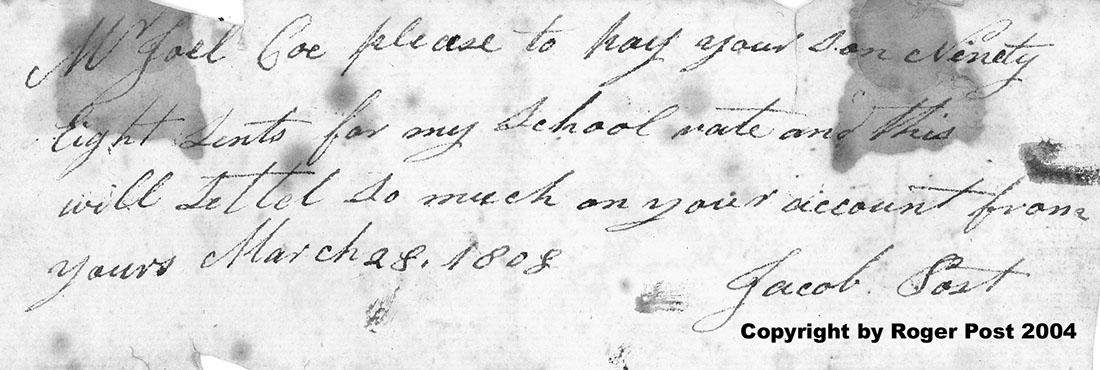
Jacob Post, Sr. operated a tannery and grain mill on what is now Stone School Road in the Town of Fleming, Cayuga Co., New York during the first several decades of the 19th Century. Note that Fleming was part of the Town of Aurelius before 28 March 1823. Among the loose papers found in the accounts ledger for the tannery was an "Order" for $0.98 issued by Jacob Post to Joel Coe. The Order directs Joel to pay $0.98 to his son - presumably Nathaniel Coe - in return for Jacob reducing Joel's debt on Jacob's account books by an equal amount. Jacob Post apparently owed $0.98 to Joel's son for the "school rate," essentially a school tax. Nathaniel Coe, Joel's younger son, was known to have been a School Teacher in later years and may have been working in a similar capacity at the time of Jacob's Order. The Order somewhat ambiguously references Joel's purchases of 28 March 1808, probably meaning Jacob's undated Order was issued at a later date but perhaps in the same year.

Images of the Order

Reverse side of an "Order" for $0.98 issued by Jacob Post, Sr. of Aurelius (later Fleming), Cayuga Co., New York to Joel Coe of Scipio, Cayuga Co., New York ca. 1808


Text of an "Order" for $0.98 issued by Jacob Post, Sr. of Aurelius (later Fleming), Cayuga Co., New York to Joel Coe of Scipio, Cayuga Co., New York ca. 1808

Transcription of the Order Text

"Mr. Joel Coe please to pay your son Ninety Eight Sents for my School rate and this will Settel so much on your account from yours March 28, 1808 - Jacob Post"


Bill of Exchange

Trading debt as a means of exchange is interesting in and of itself. The example of Joel Coe having debt held by Jacob Post and Jacob having a debt to Nathaniel Coe, and the respective debts being at least partially settled by Joel paying Nathaniel, appears to be efficient. Other examples can be found of such balancing of accounts during the early 19th Century. Jacob Post, Sr.'s Order to Joel Coe appears to be a financial instrument called a "Bill of Exchange," based on the following definition and explanation.

"The fore-runner to the modern cheque was the bill of exchange, originally a private transaction involving a money-lender. It was described by Robert Goodacre in A Treatise on Book-Keeping adapted to the use of Schools, published in 1818, as follows:   
'A bill of exchange[:]  written order drawn by one person A, on another person B, directing B to pay, on his account, a certain sum of money, therein specified, according to the direction of a third person, C.' 
The person ordering the exchange (A) was known as the 'drawer'. The person receiving the order (B) - the third party - was called the 'drawee'. The drawee would already have money on deposit from the drawer, or would be confident that the money would be repaid to him. Bills were usually endorsed (written on) by the drawee to indicate his acceptance of the bill. (C) was the 'payee', although this did not mean that he would always be paid the money in person. The payee 'directed' the payment of the money, meaning that it could either be paid to him, or he could order it to be paid to somebody else - for instance, in part-payment of one of his own debts. In such a case, the bill was endorsed by the payee with details of to whom the money should be paid, and transferred to that person." 
-- Manuscripts and Special Collections:  Cash Substitutes. University of Nottingham, UK - China - Malaysia.
https://www.nottingham.ac.uk/manuscriptsandspecialcollections/researchguidance/accounting/cashsubstitutes.aspx

Thus, Jacob would be the drawer of the Bill, Joel would be the drawee, and Nathaniel would be the payee. Jacob did not have money on deposit with Joel, but by canceling an equal amount of Joel's debt, Jacob effectively repaid Joel.

Joel Coe

Joel Coe and his family had come into Scipio, Cayuga Co., New York from Chester, Morris Co., New Jersey in 1795 and settled near Scipio Center. The account in Storke (1879) gives the location as about "three-fourths of a mile north of Scipio Center where Wm. Akin now [1879] lives." In fact, the location of William Akin's residence was slightly over 1 mile north of Scipio Center on Lot 16 as shown on an 1875 map of Scipio. Joel took up 640 acres at 1 shilling per acre, according to one account. Joel apparently sent some of his grain to market in the form of whiskey because Elisha Barnes, a somewhat later settler of Scipio who came in from Pharsalia, Chenango Co., New York in 1812, went to work for Joel in his distillery for a year before establishing his own operation in East Scipio in 1813. The account about Elisha Barnes places Joel Coe's distillery about 2 miles north of Scipio Center, but it seems more likely that it would have been on Joel's property and the distance not quite so far north.

We have to wonder why Joel Coe had to travel to Jacob Post's mill and tannery in an adjacent township, a distance of perhaps 6.5 miles. Joel could have been purchasing tanned leather. On the other hand, it is more amusing to speculate that Joel needed some malt ground for his whiskey-making operation. If we could only sample it now!

Saturday, September 22, 2018

William Smead, Jr.: Revolutionary War Veteran and Early Settler of Scipio

Family History of William Smead, Jr. (1742-1815)

William Smead II (ca. 1626-ca. 1703)

The Smead Family has a long history in the New World, beginning with a William Smead II, son of William Smead I (ca. 1595-ca. 1628), who was first brought from Gravesend, Kent, England in the fall of 1635 to the island of Barbados in the eastern Caribbean by his twice-widowed mother, Judith Stoughton Denman Smead. The family subsequently arrived at Dorchester in the Massachusetts Bay Colony in 1636. Judith died there about 3 years later. William Smead II lived at Dorchester over the next two decades, removing to Northampton, Hampshire Co., Massachusetts in 1660, not long after marrying Elizabeth Lawrence. In 1684, William and Elizabeth removed to Deerfield, Franklin Co., Massachusetts where William died ca. 1703.

John Smead I (1673-1720)

Among the children of William Smead II and Elizabeth Lawrence was a son, John Smead I (an earlier son of the same name died young) born 27 August 1673 at Northampton, Hampshire Co., Massachusetts. John married Anna Weld at Deerfield on 22 November 1699. They resided at nearby Wapping. John was wounded by Indians during the "Deerfield Massacre" of 1704 and carried a musket ball in his thigh for the rest of his life. Thus began what seemed to be a propensity of Smeads to suffer Indian attacks, perhaps because they repeatedly settled on the frontiers of the day. John served as a Selectman and Assessor before his death at Wapping on 30 April 1720.

Ensign William Smead, Sr. (1706-1797)

[NOTE:  William Smead, Sr. appears with the surname spelling "Smeed" on his tombstone and in most contemporary records. Earlier and later generations generally used "Smead."]

This William Smead -- who might also be considered another William Smead I given his son and grandson named William -- was born to John and Anna Weld Smead at Deerfield on 22 October 1706. At the age of 27, William became a Proprietor of the Upper Township on Ashuelot River in 1734 with the payment of 5 pounds for an 8-acre house lot in the wilderness up the Connecticut River. The initial lots would accommodate about 60 families under a land grant from the Massachusetts Bay Colony. This area would later become Keene, Cheshire Co., New Hampshire. Year-round occupancy of the new settlement began in the spring of 1737 after several years of summer work laying out the house lots and surveying additional lots to support agricultural activity.

William married Phebe Partridge on 9 November 1738 at Medway, Norfolk Co., Massachusetts. As far as known, Phebe accompanied her husband back to the Upper Township on Ashuelot River following their marriage. William was by this time a Sergeant in the local militia, and events on the frontier would require his service within the following decade. King George's War, later locally known as the Old French and Indian War, caused removal of all the settlers from the Upper Township in March 1747. Where William moved his family is not evident but may have been to Deerfield or to Medway where Phebe's mother yet lived. William, however, returned to the frontier to serve as Sergeant in Captain Josiah Willard, Jr.'s Company at Fort Dummer (near present-day Brattleboro, Windham Co., Vermont) and at Ashuelot for the duration of the War, mustering out on 26 October 1748.

William and Phebe probably returned to the Upper Township on Ashuelot River in the spring of 1749. The settlement largely had been destroyed by the French and Indians, necessitating reconstruction of houses and outbuildings. In 1753, the Proprietors after many petitions to the government of New Hampshire finally succeeded in getting their land grant from Massachusetts rechartered as Keene by New Hampshire to reflect the contemporary colonial borders. The Smeads again seemed to attract French and Indian attacks with the outbreak of the Seven Years' War, locally called the New French and Indian War. William's military rank was specifically noted as Ensign between 1755 and 1760, indicating continuing militia service while he also served 4 years as Selectman.

The family remained in Keene until about 1761 when William sold extensive tracts of land after they had already removed to nearby Walpole, Cheshire Co., New Hampshire. William and Phebe resided at Walpole through 1767. By 1771, the family was in Windsor, Windsor Co., Vermont where they remained. Ensign William Smead, Sr. died 26 October 1797 at Windsor.

William Smead, Jr. (ca. 1742-1815)

The first two sons of William Smead, Sr. and Phebe Partridge, Asa and Joel, died in 1744. William and Phebe later would have two more sons bearing those names. William Smead, Jr. -- who might also be called William Smead II given his father and son named William -- was the third son of William and Phebe, probably born in 1742 at the Upper Township on Ashuelot River. William, Jr., as far as known, grew up on the family lands there and presumably removed with his parents to Walpole ca. 1761. He married Mehetebell Brown at Walpole on 20 August 1767, the ceremony being performed by Rev. Thomas Fessenden of the newly formed Walpole Church of which William's father, and probably mother, were founding members earlier that year.

William Smead, Jr. appears as a Head of Household in a census taken at Windsor in 1771, indicating that he and Mehetebell had removed there from Walpole at about the same time as his parents. William's deed at Windsor was reconveyed in 1772 following a change in jurisdiction of the area from New Hampshire to New York. By 1777, William, Jr. is censused at Cornish Township, Sullivan Co., New Hampshire. This area is directly across the Connecticut River from Windsor.

William Smead, Jr. in the Revolutionary War

The Revolutionary War did not seem to affect William in 1777, despite the Battles of Saratoga being fought in September and October, not far from Vermont. However, Major Ebenezer Woods directed that men from Windsor conduct scouting activities between June and September 1778. A William Smead served as a Scout for 3 days during this time. It is likely that the "Wm. Smead" shown on the rolls of Vermont was William Smead, Jr. because his father was then 71 years old.

William was not called to serve again until 1780. Between 2 August and 8 August of that year, William was a member of Captain John Mercy's Company (also seen as Captain John Marcy's Company) for 6 days when they marched 20 miles in pursuit of Tories on the order of Colonel Ebenezer Woods of Windsor. William's pay rate was 1 shilling 4 pence per day. He received a mileage rate of 4 pence per mile. His total pay for this period was 14 shillings 8 pence.

William again served from 20 October to 31 October 1780 in Lieutenant Asahel Smith's Company, Vermont Militia, marching to Fort Fortitude by order of Lieutenant Colonel Safford. The Fort was located at Bethel, Windsor Co., Vermont near the White River, but the exact location has been lost. Captain Smith's Company marched 40 miles during this time, for which William's total pay was 1 pound 8 shillings.

No further reference to William Smead, Jr. appears in the Vermont records of Revolutionary War soldiers. We can presume that William returned to his land in or near Windsor after each of his brief forays scouting or with the militia. In terms of Revolutionary War service, William's total time of 20 days was minimal and may not have included any actual combat. Nevertheless, we honor the fact that William was a patriot who contributed to securing independence for the Colonies.

William Smead, Jr. and Settlement of Scipio

No records of William and Mehetebell Brown Smead in the decade between the William's last Revolutionary War service and the first federal census in 1790 are readily accessible. At some point, the family must have removed from the area of Windsor because William appears at Queensbury, Washington Co., New York (now Queensbury, Warren Co., New York) in the referenced census, adjacent to David Eddy. The Smead and Eddy families must have moved westward together to settle in the Town of Scipio, Cayuga Co., New York before 1800 because they are again adjacent in the 1800 federal census of Scipio, thus beginning what would be a long association between the families. No mention of William Smead, Jr.'s settlement in Scipio appears in Storke's (1879) account of this period. One bit of evidence may be gleaned from the date of David Eddy's settlement, as known from an account by his son, Owen, who stated that David moved to Scipio when Owen was 8 years old. That would make the year ca. 1795. We can speculate that William Smead, Jr.'s family came in at the same time, given their adjacent locations in 1800.

William Smead, Jr. probably resided on present-day Bergerstock Road in the Town of Scipio. His oldest living son (as of 1800), William Smead III , appears there (with surname spelled "Smeed") on an 1853 map of Scipio, presumably having inherited his father's land. The Smead farm was on the north side of the block where David Eddy, whose farms were on present-day Manchester and Black Street roads, settled. William Smead, Jr. died on 17 February 1815. His wife, Mehetebell, died on 6 January 1823. Both are buried in the Eddy Cemetery on Manchester Road.

Monument for Revolutionary War veteran William Smead, Jr. and his wife, Mehetebell Brown Smead in Eddy Cemetery, Manchester Road, Scipio, Cayuga Co., New York

Children of William Smead, Jr. and Mehetebell Brown Smead

William and Mehetebell had four living sons when the family settled Scipio:  William Smead III (aka William Smead, Jr.) (1779-1860), Jedediah Levens Smead (1781-1865), Marshall Smead (1784-1853), and Allen Smead (1788-1858). Their first son, David Smead, died at Walpole in 1768, probably at or near birth. One source references a William Smead baptized on 17 May 1772 at Windsor. This William may have died young because William Smead III appears to have been born in 1779. Other, unrecorded, children also may have been born and died young during the 11-year gap between David and William Smead III.

With the exception of William Smead III of  Bergerstock Road, the sons of William and Mehetebell eventually removed to the western portion of New York State settling in Livingston and Genesee counties, where they left many descendants, including some who later returned to Scipio.


Wednesday, September 5, 2018

1837-1838 Promissory Note by Jacob Post, Jr. (probably) to Elsie Schenck Voorhees Peterson

The Note


Promissory Note believed to have been made by Jacob Post, Sr. to Elsie Peterson payable 20 April 1838
The Promissory Note transcription follows:  "$128:. For value recived I promis to pay Else Peterson on hunderd an twenty ate dolars on Demand with use Aprel the 20 Fleming 1838"

Provenance of the Note

The Promissory Note appears among several loose papers in the Ledger of Jacob Post, Sr. handed down in the family for five subsequent generations. No signature appears on the note. One method of cancelling a legal document in the 19th Century was by tearing or cutting off the signature. That appears to be the case with this Note because the blank lower part of the actual document (not all shown above) does have a rectangular area below "Fleming 1838" removed (slightly visible at the lower margin of the image).

Absence of a signature makes the originator of the Note somewhat speculative, but it was likely either Jacob Post, Sr. or his son Jacob, Jr. Given the $128 sum involved and reference to "use," the Note may have been for the use of a farm. Jacob Post, Sr. already had a farm of 127 acres in 1838, which turned out to be the year of his death, suggesting that Jacob Post, Jr. was more likely to need land to farm and may have been the person making the Note. Comparison of handwriting between the Note and Jacob, Sr.'s Ledger is not very revealing, but spelling in the Note does not seem as good as that exhibited by Jacob, Sr. My tentative assignment of the Note's authorship is to Jacob Post, Jr.

Jacob Post, Jr. was born on his father's farm on or near present-day Stone School Road in the Town of Fleming on 20 January 1809, son of Jacob, Sr. and Jannetie (Jane) Nevius. He married Esther Ann Gregory, it is believed in 1829, and they had a daughter, Clarisa A. Post. Esther Ann died in 1833 and Clarisa A. in 1837. Jacob Post, Jr. would have been a widower, possibly in his father's household, at the time the Note was executed. He would later marry Betsey Ann Allen, a granddaughter of pioneer settler Gideon Allen of Scipioville in the Town of Scipio, Cayuga Co., New York.

Elsie Peterson

Christopher Peterson, son of Cornelius Peterson, Jr. and Maria Post, married Elsie Schenck Voorhees on 26 March 1823. They resided on the western shores of Owasco Lake in the Town of Fleming, Cayuga Co., New York. Elsie was the daughter of Abraham Voorhees and Elsie TenEyck. She was born 4 September 1801. Unfortunately, Christopher died only 10 years later, on 23 February 1833, leaving Elsie with five children to raise.

Elsie's oldest son, Cornelius A. Peterson, would have been only 13 years old in 1837 when the Note probably was drawn up, perhaps for a use of 1 year terminating 20 April 1838. Cornelius A., however capable for his age, likely would not have been able to commence farming at that time. We can speculate that Elsie might have rented all or part of her farm for income.


Saturday, September 1, 2018

Appointment of Levi S. Tryon and Isaac S. Suydam as Appraisers of the Jacob Post Estate - 1839

Jacob Post, Sr. (1773-1838)

Jacob Post, Sr. was born 16 September 1773 in or near Neshanic, Hillsborough, Somerset Co., New Jersey, the son of Christopher Willemsz. Post and Margaret Jorisse Bergen. Jacob married Mary Stout, daughter of Samuel and Eunice Stout, ca. 1795 while still in New Jersey. When Christopher and Margaret removed with some of their children from New Jersey to the western shore of Owasco Lake in 1796, Jacob and Mary accompanied them. The Post family took up land in Lot 91 of what later became the Town of Fleming, Cayuga Co., New York, south of present-day Stone School Road. The related Peterson family came in at the same time, settling on adjacent Lot 83 to the north.
"In 1796, Wm. Post, at the request of his father, who was then in New Jersey, came, in company with Abram Van Ness, his brother-in-law, with whom he had removed to Ovid, Seneca county, from New Jersey, in 1794, to examine lot 91, for which his father was then negotiating. Wm. Post, having sent a satisfactory description of the lot to his father, settled where David B. Post now lives, and Van Ness, who married Post's sister Lena, where Horace Post now lives. This same year his father, Christopher Post, came in from New Jersey with his wife, Margaret, his youngest son, Jacob, and his wife, Mary, his daughter, Mary, and her husband, Cornelius Peterson, and his youngest daughter, Ida, who was then unmarried, but subsequently became the wife of John Brokaw, in company with Cornelius Peterson, father of his son-in-law Cornelius, and his family, which was large. Christopher took up 472 acres on lot 91, and settled in the south-east corner, where Ebenezer Gilbert now lives [NOTE:  Should be the northeast corner because that is where the Post farms were located and where Ebenezer Gilbert lived - R. A. Post]. They came with wagons, over the mountains, fording streams which were bridgeless. Peterson settled on lot 83, where George Peterson, his grandson, now lives. Christopher Post died on the homestead March 17th, 1816."
-- Elliot G. Storke, History of Cayuga County, New York 1789 - 1879 (Syracuse, Onondaga Co., NY, D. Mason & Co., 1879), Internet Archive http://archive.org/, p. 377
Jacob and Mary had a daughter, Margaret (aka Margret) Post, born 10 January 1797 at Owasco Lake. Mary died some time after the birth of Margaret. Jacob subsequently married Jannetie (later anglicized to Jane) Nevius, daughter of Martynes Nevius and Ida Hoagland, ca. 1801. By then, Cayuga County had been formed, and Lot 91 was part of the Town of Aurelius of that county. Jacob and Jannetie had 12 children between 1803 and 1824. Some of the children would later settle in western New York State and in Ohio.

Jacob Post, Sr. constructed a log house on the south side of present-day Stone School Road sometime between 1801 and 1810, after having lived with his parents during their initial settlement along Owasco Lake. He operated a horse- or oxen-powered feed mill and a tannery for many years before he died intestate in October 1838. Jannetie, his widow, survived until December 1858.

Appointment of Appraisers in Surrogate's Court for Jacob Post, Jr.'s Estate

On 23 February 1839, Jacob Post, Jr. petitioned the Surrogate's Court at Auburn, Cayuga Co., New York for Letters of Administration on the estate of his father. At the same time, the Court appointed two Appraisers to value the personal estate of Jacob Post, Sr., deceased.

Appointment of Appraisers Levi S. Tryon and Isaac S. Suydam for the estate of Jacob Post, Sr., late of the Town of Fleming, Cayuga Co., New York

Reverse side of Appointment of Appraisers Levi S. Tryon and Isaac S. Suydam for the estate of Jacob Post, Sr., late of the Town of Fleming, Cayuga Co., New York

The Appraisers appointed by Surrogate Thomas Y. How, Jr. were Levi S. Tryon and Isaac S. Suydam. Some biographical information on Levi S. Tryon appeared in a previous blog post. Suffice it to say that Levi was a prominent former mill owner who owned a farm on present-day Silver Street less than 2.5 miles by road from the Post residence in the Town of Fleming.

Isaac S. Suydam

Isaac S. Suydam, son of David Suydam and Abigail Grover, lived on his father's farm on present-day Silver Street Road near the corner of Stone School Road. This placed Isaac even closer than Levi Tryon to the farm of Jacob Post, Sr., about 1.6 miles by road. The familiarity of the Post and Suydam families is evidenced by the fact that Jacob Post, Jr., Administrator of his father's estate, was censused adjacent to David Suydam's household in 1840 although Jacob may have been in his father's household near Owasco Lake the prior year. Isaac would have been 30 years old at the time he was appointed as an Appraiser of Jacob Sr.'s estate in 1839. Isaac S. Suydam apparently never married and died 1 May 1875.

There was another, older Isaac Suydam, possibly an uncle of Isaac S. Suydam, who appears with Jacob Post, Sr. in an 1807 list of subscribers to fund construction of the "Meeting House of the United Congregation of the Reformed Low Dutch church at the Owasco Outlet" (Sand Beach Church). The Post and Suydam families therefore belonged to same congregation. The elder Isaac Suydam was censused adjacent to David Suydam at Fleming in 1830 but does not appear there in 1840. Probate records show that an Isaac Suydam died intestate at Scio, Washtenaw Co., Michigan prior to 23 March 1853, leaving goods, chattels, or credits within Cayuga Co., New York. These facts render it somewhat unlikely that the elder Isaac Suydam was the one appointed as an Appraiser of Jacob Post, Sr.'s estate.

Christopher Peterson Residence on Owasco Lake in 1901

The Peterson Family of Owasco Lake, Fleming, Cayuga Co., New York

Cornelius Peterson and his wife, Hannah (Annatie) Parsell, removed with their family from Hillsborough, Somerset Co., New Jersey to the western shore of Owasco Lake in 1796. They settled in what is now the Town of Fleming, Cayuga Co., New York. Their recently married son, Cornelius Peterson, Jr., and wife Maria Post, accompanied the elder Petersons to Owasco Lake, as did her parents and some siblings, the Christopher Post family. The Petersons settled primarily to the north of present-day Stone School Road on Lot 83.
"CORNELIUS PETERSON, JR. emigrated to this county at the same time his parents did and settled on a portion of the land that his father purchased. On May 5, 1796, a few weeks before he came to Fleming, he married Maria Post, daughter of Christopher and Margaret Post who also joined the Petersons on their journey to the 'Lake Country.' Cornelius eventually built a commodius dwelling for his family (Ross Farm) and other descendants--Schuyler (Misses Peterson home), George R. (home was located at site of Polish Home), and Dodge home also lived on the Lake Shore."
-- Sheila Saft Tucker, The Township of Fleming Cayuga County, New York 1823-1973 (Auburn, Cayuga Co., NY, Sheila Saft Tucker, 1973), p. 85

History of the Peterson/Ross House

Christopher Peterson house north of Stone School Road on present-day State Route 38 (West Lake Road) in the Town of Fleming, Cayuga Co., New York in 1901 - photo found with old papers in California and sent to the author

The preceding quotation attributes construction of the house on the present-day Ross Farm at Peterson Point, on State Route 38 (West Lake Road) north of Stone School Road, to Cornelius Peterson, Jr. The above photograph of the Peterson/Ross house from 1901 shows that it was originally constructed in the Italianate style, which came into vogue in the United States by 1840. Cornelius died on 12 April 1847; thus, he probably constructed the home late in his lifetime, following the death of his wife, Maria, in 1836.

Cornelius Peterson, Jr. and Maria Post had only one son, Christopher, who married Elsie Schenck Voorhees in 1823 but died in 1833. Thus, it is unlikely that this Christopher Peterson ever lived in the Peterson/Ross house. Similarly, his sister Maria had died in 1830. An 1853 map of Fleming shows "I. M. & A. Peterson" (see Lot 83) occupying this house. The most likely Petersons to be living together and represented by these initials are Ida Brokaw Peterson, Margaret B. Peterson, and Anna Peterson, all daughters of Cornelius and Maria and their only living offspring in 1853. George Rapleyea Peterson, son of Christopher and Elsie Peterson and nephew of Ida, Margaret, and Anna, lived with them in the Peterson/Ross house by 1855 and worked the farm. After George married Mary Lucena Post in 1858, it appears that his aunts moved to a house on the corner of Stone School Road while George and Mary Lucena lived in the Peterson/Ross house as shown on an 1859 Map of Fleming.

The son of Christopher and Elsie, Cornelius A. Peterson, husband of Helen Post, next occupied the Peterson/Ross house from before 1875 until his death in 1882, as shown on an 1875 map of Fleming (C. Peterson on Lot 83). By then, George Rapleyea Peterson had moved a short distance northward to a Peterson house (G. R. Peterson on Lot 83) that stood on land later occupied by the Polish Home Camp (now gone). A photo of the latter Peterson house, which eventually was destroyed by fire,  appears on page 86 of The Township of Fleming Cayuga County, New York by Sheila Saft Tucker (1973).

Cornelius A. Peterson and Helen Post had a son, Christopher, husband of Alberta Adams, who presumably next occupied the Peterson/Ross house as shown on a 1904 map of Fleming, remaining there until after 1915. By 1920, Christopher had retired from farming and removed to Auburn, Cayuga Co., New York. Determining the subsequent ownership and occupancy of Peterson/Ross house up until World War II would require further research. Charles E. Ross, son of Charles P. and Bertha E. Ross (who lived on the Fleming-Scipio Townline Road) owned the house by the early 1950s, if not sooner. After Charlie died in 1986, his wife, Mae Elizabeth "Betty" or "Bess" Coons Ross resided in the home for many years before her death in 2006. The home is believed to remain in the Ross family.

Present-day Appearance of the Peterson/Ross House

Peterson/Ross house contemporary view from Google Earth

The cupola formerly present on the upper portion of the tall Italianate tower on the front of the Peterson/Ross house in 1901 has been removed. The tower now is capped with small, gabled roof above the second-story tower windows, which also have been replaced. A two-story bay visible on the south (left) side of the house in 1901 is no longer present. Finally, what appears to have been a relatively flat roof in 1901 has been replaced with a hipped roof. Let's hope this house is good for its second (approximately) 180 years!